
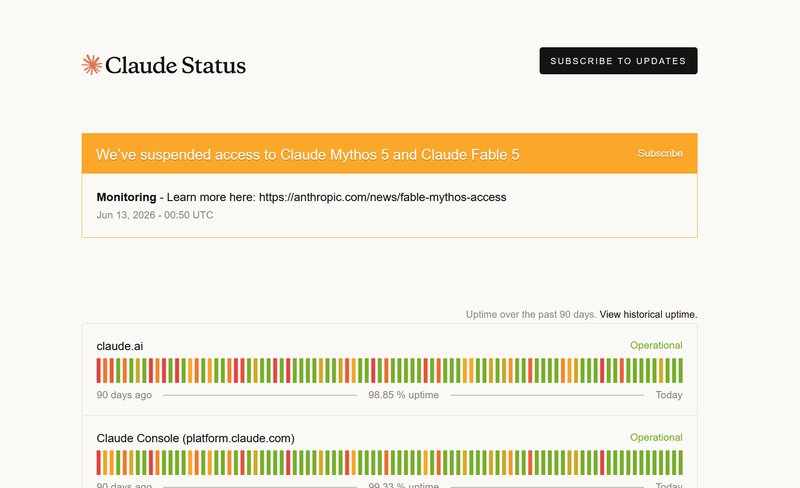
The news arrived without warning and redraws the boundaries of Large Language Model access in the United States. The Trump administration has decided to eliminate the restrictions that weighed on Anthropic’s Mythos and Fable models, and the company itself confirmed it will restore access to Fable starting July 1. A move that, beyond the political noise, carries concrete consequences for those working with AI in on-premise and self-hosted environments.
What changes for the constrained models
Restrictions – typically tied to export controls or limitations on the use of certain technologies – had created a gray area for organizations intending to run these models on their own servers. With the removal of these constraints, Mythos and Fable become legitimate candidates for local deployments without the need to go through cloud providers or navigate complex compliance checks. This is not only a bureaucratic simplification: for many companies, especially in Europe, the ability to download and run a model locally is the prerequisite for ensuring data residency and complying with regulations such as GDPR.
The weight of on-premise in the AI game
Trump’s decision touches a raw nerve in the industry: access to the most advanced models is often conditioned by political choices that can exclude entire regions or force cloud-dependent architectures. For teams evaluating on-premise AI infrastructure, every model made available without restrictions adds an option to the toolbox. There are no details yet on Mythos and Fable’s technical specs – required VRAM, quantization levels, context windows – but the mere reopening of access terms reduces vendor lock-in risk and broadens the field of possibilities for those designing local inference pipelines.
A look at the regulatory landscape
The lifting of restrictions is not an isolated event. It fits into a broader debate over AI control, where US administrations have oscillated between driving innovation and curtailing the spread of technologies deemed strategic. In this context, the availability of models like Mythos and Fable beyond tightly regulated channels could spur investment in inference hardware, a segment AI-RADAR closely tracks to assess TCO and sustainability. For organizations deciding whether to build a local cluster or rely on the cloud, the removal of regulatory hurdles eliminates a critical variable from the economic equation.
Technical perspectives still to be explored
For now, information on Mythos and Fable is thin. No benchmarks have been released, nor details on underlying architectures. Yet for those monitoring on-premise deployment, the value of the news lies mainly in the direction it signals: when political constraints loosen, the self-hosted AI market gains ground. The real test will come when technical teams can get their hands on the model weights and measure performance on actual hardware, but the signal for now is clear: the road to local, governable, and sovereign AI just became a bit less steep.








💬 Comments (0)
🔒 Log in or register to comment on articles.
No comments yet. Be the first to comment!