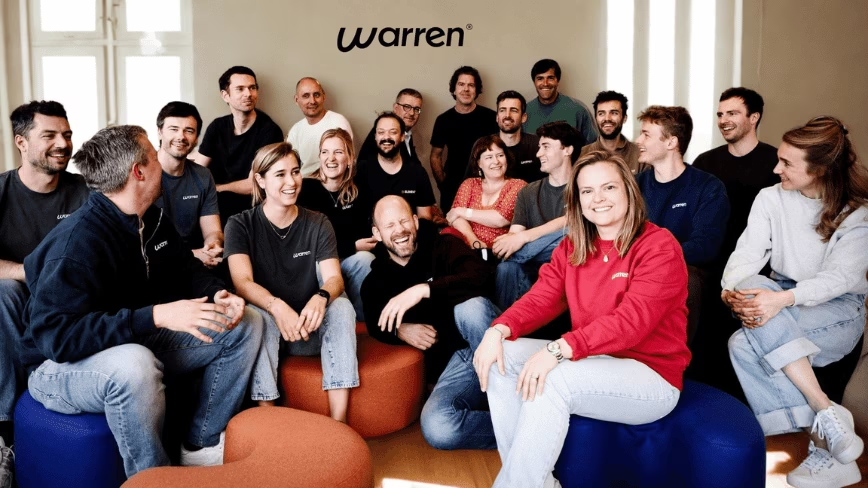
A second-hand car. That is, at best, the lump sum the average Belgian worker can expect after forty years of career. It is the grim snapshot that spurs Warren, a Ghent-based fintech, which has just raised €10 million in a seed round led by Motive Ventures (the venture arm of Motive Partners) and F Capital, with backing from existing investors.
The declared mission is to straighten a fragmented and opaque workplace pension system. But the real game today is not played only on financial leverage or user experience. It is played on the field of digital sovereignty, where fintech and regulation clash with the same intensity that organizations face when deploying large language models in-house.
Belgium’s silent pension disaster
The figure is as dry as it is alarming: after a lifetime of contributions, many Belgian employees end up with a pension pot worth less than a few thousand euros. The culprit is not just the limited generosity of company plans, but the inefficiency of an ecosystem that blends insurance products, collective funds and individual plans without real competition or transparency. Warren intends to change the rules by using technology to cut intermediation costs and give power back to savers.
Warren’s bet and fresh capital
The €10 million round will accelerate platform development and extend the user base beyond the first few thousand clients. Motive Ventures brings not only capital but deep knowledge of the European insurance and banking landscape, while F Capital reaffirms the confidence of those who had already invested. The deal, by early-stage standards, is significant, but the sum is not what strikes: the true stakes lie in data management.
Where the data goes: cloud and digital sovereignty
Any platform that administers supplementary pensions handles highly sensitive personal information: identity, income, employment history, investment preferences. In Europe, and in Belgium in particular, GDPR imposes strict constraints on the localization and processing of such data. Relying on a public cloud, however certified, means accepting a model where physical control remains in the hands of a US hyperscaler, with all the uncertainties triggered by the Cloud Act and extraterritorial requests.
Warren has not disclosed its architecture, but the case is emblematic: for any entity dealing with financial data, the choice between cloud and on-premise—or hybrid—infrastructure is much more than a cost item. It is a decision that touches customer trust, regulatory compliance and operational resilience. And it must keep an eye on scalability: serving tens of thousands of users without degradation requires computing power that, historically, only the cloud could provide with elasticity. Today, however, accelerated hardware and self-hosting frameworks make entirely local architectures plausible even for complex workloads.
Lessons for those looking at on-premise AI
Warren’s story is a wake-up call for anyone evaluating the adoption of artificial intelligence within company boundaries. Managing pensions is not, in principle, different from running inference on an LLM that processes medical records or legal contracts: in both cases data sovereignty is a non-negotiable requirement. The same questions a CTO should ask—where does my data reside? Who can access it? What is the true cost of a self-hosted architecture?—are the ones that determine the success or failure of a fintech that promises transparency.
Those who follow the debate on local model adoption know the trade-off is always between control and agility. The cloud offers instant provisioning and a seemingly low TCO, but exposes to lock-in risks and unpredictable operational costs as volumes grow. On-premise, with the right GPU and VRAM sizing, returns full control but demands vertical skills and higher upfront investments. Warren, while not declaring its stack, fits squarely into this groove: the pension 4.0 game will not be won by whoever has the best algorithm alone, but by whoever can prove they guard data with the same care they guard their clients’ savings.
In a continent where digital trust has become currency, every startup that processes sensitive data becomes a laboratory for the future of local deployment. It is exactly the kind of scenario AI-RADAR analyzes when it comes to on-premise LLMs: because technology, by itself, is never enough.








💬 Comments (0)
🔒 Log in or register to comment on articles.
No comments yet. Be the first to comment!