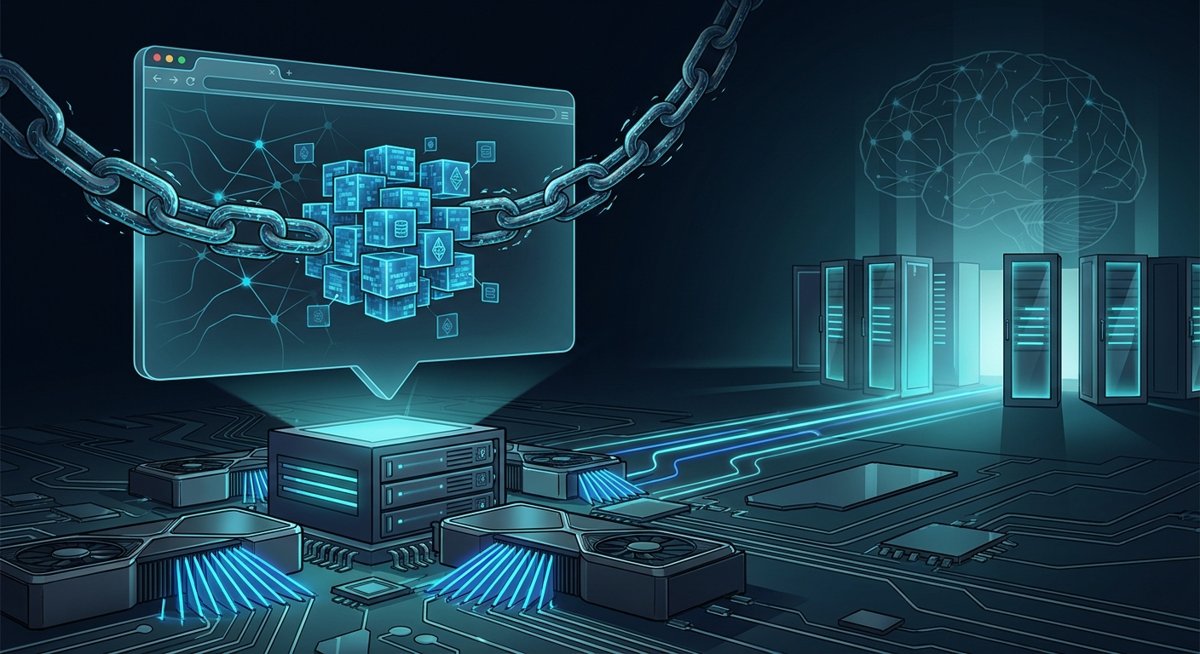
The browser as a frontier for local inference
A Reddit post signed CodeMichaelD sums up a widespread short-circuit with honesty. The goal was to build an inference engine for LLMs inside an HTML page, running a GGUF model in Q4 quantization paged into compute buffers via WebGL2 and GLSL. The ironic premise — “vibecoding your own inference engine is easy, they said” — is not an inside joke: it captures the idea that inference is mostly matrix multiplication, therefore accessible to anyone who can write shaders. The browser appears as the ideal environment: no server to configure, no GPU drivers to install, data staying on the device. But the attempt crashes on something invisible: tokenization.
This experiment is not isolated. The pressure to run LLMs locally, without going through cloud APIs, is real. Data sovereignty, latency, and operational control push developers and companies toward self-hosted or edge solutions. The browser represents the most extreme frontier of this trend: a universal runtime, already installed on billions of devices, that could turn every page into an inference endpoint. The temptation of do-it-yourself is understandable. The problem is that vibecoding tends to focus on the visible part — loading the model, multiplying matrices — and discovers late that the linguistic glue is the hardest part.
CodeMichaelD's testimony has value beyond the anecdote. It shows where technical debt accumulates in local inference projects: not in linear algebra, but in managing the vocabulary and linguistic rules that transform text into tokens. Anyone evaluating an on-premise deployment should read this story as an indicator of hidden complexity, not as a personal failure.
Tokenization: the unforgiving linguistic glue
Tokenization is not a simple word-to-number dictionary. It is a pipeline with normalization rules, special token handling, padding, and attention to byte-level BPE details. Each model has its own vocabulary, its own conventions for spaces, capitals, accents, out-of-distribution characters. An error at this stage does not produce a clear message. It produces incoherent output or crashes that are hard to isolate, because the error manifests downstream in tensor computation while the cause is upstream. This is exactly the “endless debug hell” cited in the post.
For those building self-hosted applications, tokenization is a compatibility perimeter. Even with the same GGUF file, if the tokenizer does not match the one used during training or fine-tuning, the model receives sequences it does not recognize. The result can be text that is grammatically plausible but semantically unstable, or an error that emerges only with specific inputs. Debugging is made harder by the fact that logs show the final tensor, not the point where the byte was segmented incorrectly.
The advice to clone llama.cpp finds its technical justification here. A mature runtime like llama.cpp brings with it a battle-tested tokenizer, updated to support GGUF formats and quantization variants. It is not just a shortcut to avoid writing code: it is the difference between focusing on the application problem and sinking into an implementation detail that requires model-specific knowledge. The post does not say it explicitly, but surrendering to tokenization is surrendering to an entire layer of complexity that vibecoding does not reveal.
Cloning llama.cpp is not surrender: it is repositioning
The suggestion to clone llama.cpp should not be read as simple forum advice. It signals that the local and self-hosted ecosystem already has a mature runtime capable of handling multiple GPU backends, GGUF formats, quantization, and a proven tokenizer. For anyone evaluating an on-premise or edge deployment, the question is not whether to write an engine from scratch, but whether the competitive differential lies in the engine or in integration with one's own data and processes.
Building an inference engine from scratch has a cost in debugging hours that rarely appears in initial estimates. The TCO of a do-it-yourself project includes not only development but also maintenance, managing format updates, and resolving bugs that appear only in production. Using an existing runtime shifts the cost to integration: connecting the model to proprietary data, building the preprocessing pipeline, managing security and lifecycle. This is not trivial work, but it is work that can differentiate an application.
For AI-RADAR, the point is not to recommend a single choice. It is to recognize that building the engine yourself has educational value but rarely production value. The presence of llama.cpp as a reference does not eliminate the need to understand how tokenization works or how quantization behaves on specific hardware. It only eliminates the repeatable part, the part that brings no competitive advantage. Those who want to make a difference should focus on what is specific to their context: data quality, required latency, memory constraints, sovereignty.
WebGL2 and WebGPU: the runtime is not just linear algebra
WebGL2 supports compute shaders, but it was not born for inference. The limits in buffers, memory management, and debugging are well known to developers of complex graphics applications. The attempt to page a GGUF model into compute buffers inside an HTML page is a demonstration of ingenuity, but also a reminder of the constraints of an API designed for graphics. The difference between drawing a scene and multiplying tensors is not only conceptual: it concerns memory allocation, synchronization, numerical precision, and the ability to isolate errors.
The arrival of WebGPU shifts the center of gravity, because it offers a more modern compute model and more direct access to GPU resources. But the lesson remains. An inference runtime is not just a sequence of matrix multiplications. It must handle tokenization, tensor preparation, CPU-GPU communication, VRAM management, and compatibility with quantization formats like Q4. Even with WebGPU, debugging a tokenization error does not become easier: only the layer where it manifests changes.
For edge and on-premise deployments, this has concrete implications. The choice of backend is not neutral with respect to runtime complexity. WebGL2 may be sufficient for experiments but not for workloads where stability and maintainability matter. WebGPU represents a promising direction, but it still requires a mature engine underneath. Anyone evaluating the browser as an inference platform must consider not only compute power but also the maturity of the development ecosystem, format support, and the availability of debugging tools.
Data sovereignty and TCO: the right question
The fact that someone tries to run an LLM inside an HTML page with WebGL2 reveals real pressure: running models locally, without servers, with minimal latency and data that never leaves the device. This pressure is not only technical. It reflects a demand for data sovereignty and operational control that runs through the entire AI sector. But sovereignty does not only mean where the model runs. It also means having control over the runtime, updates, security, and dependencies.
A do-it-yourself inference engine seems to offer maximum control. In reality, it often hands control over to complexity: every tokenization bug, every format incompatibility, every model update becomes a maintenance problem. The TCO of a home-built engine can quickly exceed the cost of a mature runtime, especially if the team lacks specific skills in tokenization, quantization, and inference pipelines. Sovereignty is better exercised by consciously choosing which components to keep under control and which to entrust to a proven ecosystem.
For AI-RADAR, the signal of this post is that the browser frontier is not yet ready for vibecoding. That does not mean it never will be. It means that anyone evaluating an on-premise or edge deployment today must ask the right question: not “can I build an engine?” but “where is the differential value of my application?” The answer, in most cases, is not in linear algebra. It is in data, processes, and integration with the operational context.
What to watch in the coming months
The debate on in-browser inference will not end with a Reddit post. There are signals to monitor to understand whether this frontier will become practical. The first is WebGPU adoption: if major browsers stabilize the API and runtime engines support it natively, the browser could become a more credible inference environment. The second is the evolution of quantization formats and runtimes like llama.cpp: every improvement in GGUF and tokenization handling lowers the entry cost for those who want to run models locally.
Another signal is the growth of libraries and frameworks that abstract browser complexity, shifting the problem from writing shaders to configuring a pipeline. If these libraries incorporate proven tokenizers and manage memory transparently, the gap between prototype and production will narrow. But as long as tokenization remains an “endless debug hell” for those implementing it from scratch, the browser will remain a territory for experimenters, not for mission-critical deployments.
For those working on self-hosted and on-premise stacks, the message is twofold. On one hand, the hidden complexity of tokenization justifies adopting mature runtimes. On the other, the push toward the browser and the edge cannot be ignored: it signals that demand for local inference will grow. Organizations that can separate the engine from integration, and that invest in data quality and lifecycle management, will be better positioned when WebGPU and browser runtimes make this frontier more accessible.


💬 Comments (0)
🔒 Log in or register to comment on articles.
No comments yet. Be the first to comment!