
WhatsApp and Meta AI: Incognito Mode for Private Conversations
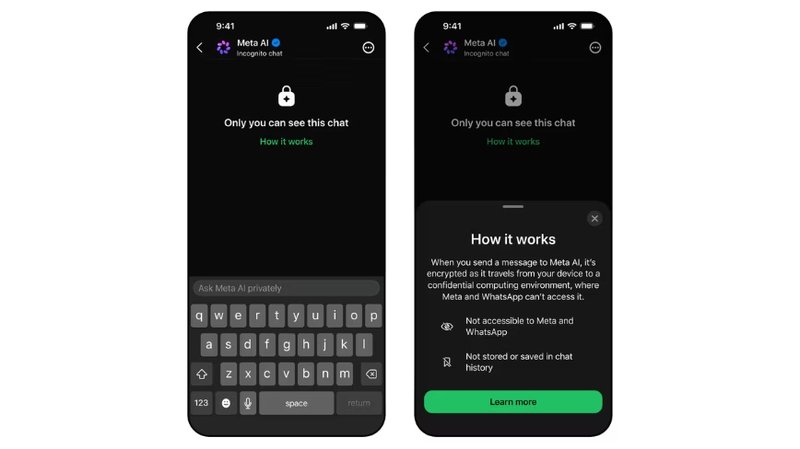
Meta has announced the introduction of a new "incognito" mode for chats with Meta AI within WhatsApp. This feature, designed to enhance user privacy, allows interaction with the Large Language Models (LLM)-based assistant without conversations being permanently saved. The initiative reflects a growing focus by technology companies on managing personal data in the era of generative artificial intelligence.
Meta's move is part of a broader context where privacy protection and data sovereignty have become absolute priorities, not only for end-users but also for organizations implementing AI solutions. For businesses, particularly those operating in regulated sectors, the ability to control where and how data is processed and stored is a critical factor in choosing deployment architectures.
Technical Details and Privacy Implications
The operation of the "incognito" mode is simple yet effective: Meta stated that conversations initiated in this mode are not saved. Furthermore, messages automatically disappear by default once the chat is closed. This approach ensures that no trace of the interactions remains, offering a level of confidentiality comparable to private browsing windows in web browsers.
From a technical perspective, implementing such mechanisms requires careful management of the data processing pipeline. For LLMs, this means that prompts and responses must not persist beyond the active session, a requirement that can influence caching and memory management strategies. For companies considering on-premise LLM deployment, the ability to configure such stringent data retention policies is a significant advantage, as it allows adherence to privacy regulations like GDPR and maintains full control over their information assets.
Enterprise Context and Data Sovereignty
The introduction of an "incognito" mode for AI interactions on a consumer platform like WhatsApp has important implications in the enterprise world as well. Organizations evaluating the adoption of LLMs for internal purposes, such as customer support, content generation, or data analysis, often face stringent compliance and security requirements. The guarantee that sensitive data is not retained or can be deleted upon request is fundamental.
In this scenario, on-premise or hybrid deployment solutions gain traction. They allow companies to keep their LLMs and data on controlled infrastructures, often in air-gapped environments, ensuring data sovereignty and reducing risks associated with sharing information with external cloud service providers. The evaluation of the Total Cost of Ownership (TCO) for an on-premise deployment includes not only hardware costs (GPUs with adequate VRAM for inference, storage) and software, but also the intangible benefits related to security and regulatory compliance. AI-RADAR, for example, offers analytical frameworks on /llm-onpremise to evaluate the trade-offs between control, performance, and costs in these contexts.
Future Prospects for AI Privacy
Meta's decision to integrate an "incognito" mode into WhatsApp for AI chats is a clear signal of the evolving user expectations and regulations regarding privacy. As LLMs become more pervasive, the ability to offer transparency and control over data management will become a crucial differentiating factor. This applies not only to consumer platforms but extends to all enterprise applications leveraging artificial intelligence.
For CTOs and infrastructure architects, the lesson is clear: the design of AI systems must include robust privacy and data governance considerations from the outset. Whether it's choosing between different deployment architectures, defining retention policies, or implementing anonymization mechanisms, the priority is to ensure that technological innovation goes hand in hand with the protection of sensitive information.









💬 Comments (0)
🔒 Log in or register to comment on articles.
No comments yet. Be the first to comment!