
WhatsApp and Meta AI Chats: A Focus on Privacy
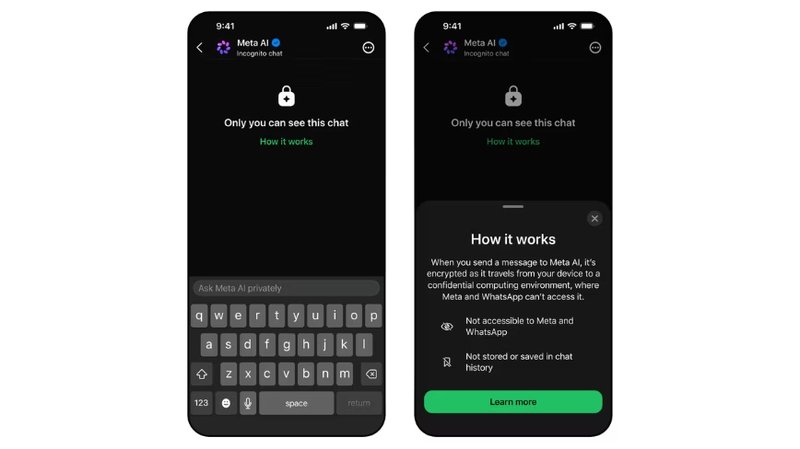
WhatsApp has announced the integration of Meta AI chats within its messaging platform, introducing a feature called "Incognito Chat." This new addition aims to offer users a way to interact with Meta's AI chatbot while maintaining a high level of confidentiality. According to the company's statements, the distinctive characteristic of Incognito Chat lies in its promise of total privacy: conversations generated with the AI chatbot would not be accessible to any external party, including Meta itself.
This move reflects a growing awareness and demand for personal data protection in the era of generative artificial intelligence. The integration of LLMs into mass communication platforms naturally raises questions about the management and access to user data, making the guarantee of confidentiality a crucial element for widespread adoption.
Implications for Data Sovereignty and Enterprise Deployments
The promise of a "fully private" AI chat raises significant questions, especially for companies and CTOs evaluating the deployment of Large Language Models (LLMs) in enterprise contexts. Data sovereignty and regulatory compliance, such as GDPR, are critical factors in choosing between cloud and self-hosted solutions. Although WhatsApp operates as a cloud service, the emphasis on the inaccessibility of conversations by the service provider mirrors a fundamental concern for those managing sensitive data.
For organizations, the ability to ensure that interactions with LLMs remain confidential and under their control is often a non-negotiable requirement, pushing towards air-gapped or bare metal architectures. This approach allows data to be kept within corporate boundaries, reducing exposure risks and ensuring full adherence to internal policies and external regulations.
Context and Trade-offs in AI Deployment
WhatsApp's approach, though applied to a consumer service, highlights a broader trend in the AI sector: the increasing demand for data privacy and control. In an enterprise context, this translates into a careful evaluation of the trade-offs between the convenience and scalability offered by cloud services and the security and customization guaranteed by an on-premise deployment. Self-hosted solutions allow companies to maintain full control over infrastructure, data, and models, mitigating risks related to third-party access.
This includes direct management of GPU VRAM, throughput, and latency, which are crucial elements for efficient LLM inference. For those evaluating on-premise deployments, AI-RADAR offers analytical frameworks on /llm-onpremise to assess these trade-offs in terms of TCO and specific requirements, providing neutral guidance for informed decisions.
Future Prospects for Enterprise AI
The introduction of features like Incognito Chat in large-scale platforms such as WhatsApp underscores the growing importance of privacy in LLM adoption. For technology decision-makers, this reinforces the need to implement robust strategies for AI data management. Whether choosing between a cloud infrastructure with certified privacy guarantees or a fully controlled on-premise architecture, the goal remains the same: to leverage AI's potential without compromising information security and confidentiality.
The ability to offer a private AI experience, even in distributed environments, will become a key competitive factor, driving innovation in both models and deployment architectures. User and business trust in AI will increasingly depend on the transparency and guarantees offered in terms of data protection.







💬 Comments (0)
🔒 Log in or register to comment on articles.
No comments yet. Be the first to comment!