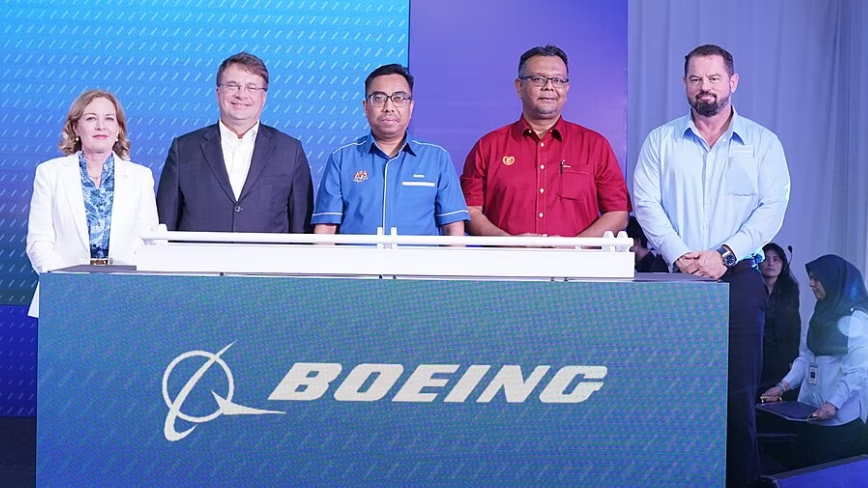
A former software manager has taken Wisk Aero, Boeing’s autonomous vertical take-off and landing vehicle subsidiary, to the Santa Clara Superior Court. The lawsuit, first reported by the Seattle Times, alleges wrongful termination and discrimination after the manager, Briahna O’Neill, internally raised concerns about reduced pre-flight software testing.
The core of the case is the pressure to accelerate the autonomous flight platform's development. According to the complaint, validation protocols were compressed to meet deadlines—a classic conflict between time-to-market and safety that is magnified in aerospace. This is not a theoretical debate: in aerial autonomy, every hurriedly tested line of code can lead to unpredictable behavior once airborne, far from any human intervention.
Wisk is developing a fully autonomous eVTOL, a system where AI makes real-time decisions on trajectory, obstacle detection, and emergency management. These software workloads run on embedded hardware onboard the aircraft—an environment that, architecturally, closely resembles an extreme on-premise deployment: limited computing power, complex updates, and no continuous cloud connection. In such a context, testing must be even more methodical because the margin for subsequent patches is minimal.
The lawsuit spotlights a tension running through the entire safety-critical AI sector. As companies push to demonstrate technological maturity and attract investment, internal engineers report that verification processes are being shortened. It is not just an ethical problem; it is a legal and reputational risk that can prove extremely costly. Boeing, already dealing with the fallout from the 737 MAX accidents, now faces another safety-related headache, however indirect.
For those operating AI on local infrastructure—whether robotics, autonomous vehicles, or industrial plants—the lesson is clear: release speed can never override the robustness of the test pipeline. Validation frameworks must be an integral part of the lifecycle, not a bottleneck to be squeezed when deadlines tighten. Otherwise, the consequences are measured not just in downtime or rollback costs, but in human lives and courtrooms.






💬 Comments (0)
🔒 Log in or register to comment on articles.
No comments yet. Be the first to comment!