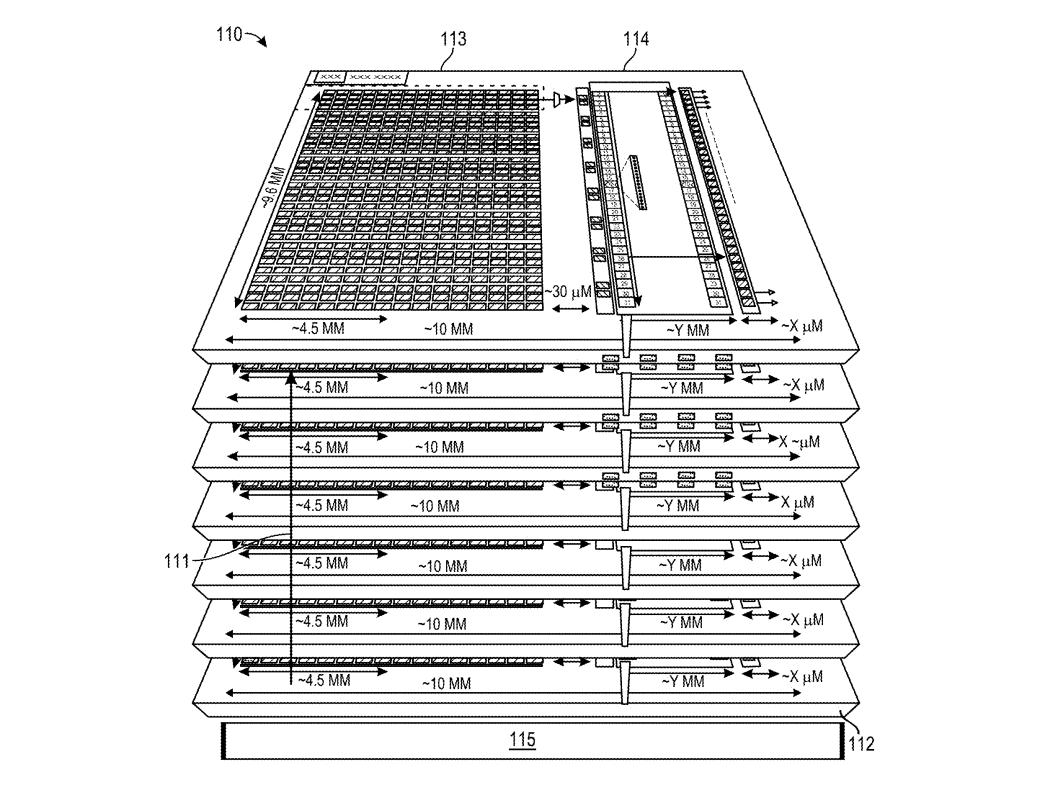
In a market where memory bandwidth is the real bottleneck for Large Language Model inference, Intel has filed a patent that could rewrite the rules of AI hardware. The technology, tentatively called XBM (likely Extended Bandwidth Memory), abandons the silicon interposer—the costly bridge that defines today's High Bandwidth Memory (HBM)—for a more streamlined, integrated approach.
At its heart is a stack of backend-transistor DRAM, connected to the rest of the system via UCIe (Universal Chiplet Interconnect Express), the die-to-die interconnect standard that Intel helped develop. Unlike HBM, which needs a silicon interposer to connect memory dies to the processor or GPU, XBM embeds memory directly on top of the logic die, reducing complexity and cost. It also features built-in repair circuitry, promising improved manufacturing yields and field reliability.
For anyone deploying language models on-premises, the stakes are clear: HBM is essential yet extremely expensive, heavily influencing the TCO of inference machines. If industrialized, a solution like XBM could democratize high-bandwidth memory, making it possible to run larger models on single nodes without always resorting to distributed clusters—with direct benefits for data sovereignty and local control.
UCIe is far from a secondary detail. While the HBM interposer ties the memory supplier to a specific chip design, UCIe is an open standard that enables modular composition: compute, memory, and accelerator chiplets could be mixed and matched to suit the workload. For a company building its own on-prem AI stack, this could mean less vendor lock-in and more flexible upgrade cycles.
Of course, a patent isn't a product, and Intel's track record in AI silicon has seen its share of unfulfilled promises. But the XBM architecture signals an attempt to attack the market from below, leveraging a design that cuts packaging costs and relies on proven standards. Should Intel manage to integrate this memory into its Xeon processors or Gaudi accelerators, the competitive landscape could shift: Nvidia currently dominates with its GPUs and HBM, but a cost-effective alternative would attract the interest of those building private data centers and edge infrastructure.
Questions remain about the actual achievable bandwidth and latency. Removing the interposer might introduce thermal or electrical trade-offs, though Intel's patents suggest ongoing work on thermal management and 3D integration. Built-in repair is a double-edged sword: it boosts resilience but adds circuit complexity that could affect power consumption.
Ultimately, XBM is more than a lab curiosity. It signals that the industry is searching for a way out of the interconnect cost impasse, and that the future of AI hardware could be chiplet-based and standards-driven. For those evaluating on-premises as an architectural choice, keeping an eye on these developments might mean anticipating the next generation of machines that balance bandwidth, cost, and manageability.







💬 Comments (0)
🔒 Log in or register to comment on articles.
No comments yet. Be the first to comment!