A Surprise Entry into the UV World
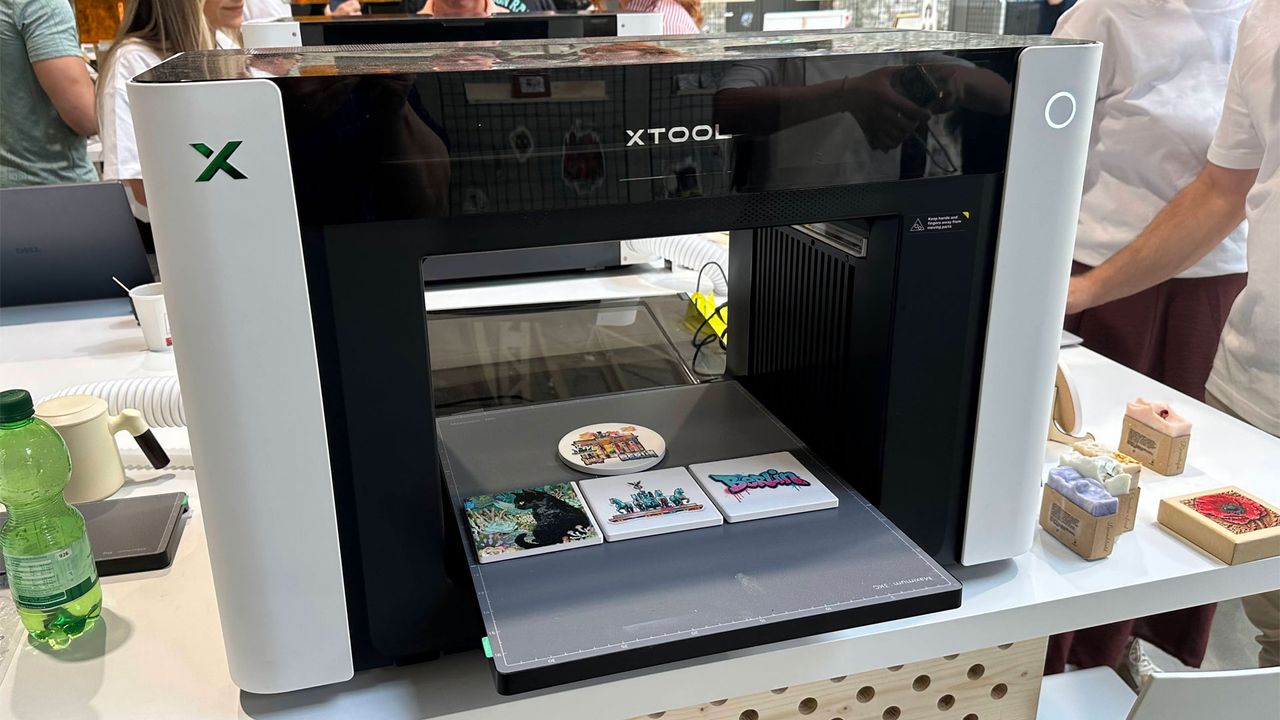
xTool, known for laser engravers and cutters, has announced the Omni 01 printer, marking its first step into the UV printing sector. Few details have emerged, but the machine can reportedly handle “any surface” up to 5 mm thick—from plastic to wood, glass to ceramic. The company’s “print it all” claim sounds ambitious but signals a clear strategy: expanding the lineup to technologies that offer more versatile customization of physical objects than laser marking alone.
UV Technology: Instant Curing
UV printing relies on ultraviolet-sensitive inks that solidify instantly upon exposure. Unlike solvent-based or heat-drying processes, rapid curing enables adhesion to non-porous and irregular substrates without warping. A printhead deposits micro-droplets of ink, and an integrated UV lamp fixes them on the fly. This combination makes the technology particularly attractive for producing signage, industrial prototypes, promotional items, and even custom packaging. xTool’s stated 5 mm thickness ceiling places the Omni 01 in a mid-tier: it’s not for deep volumetric objects, but it handles materials that traditional inkjets can’t touch.
Value for On-Premise Infrastructure
From AI-RADAR’s perspective, any machine that can complete a production cycle directly on-site deserves attention. A UV printer like the Omni 01, installed in a technical office, research lab, or small manufacturing facility, reduces reliance on external services. Design data stays within the local network, and iteration time shortens: a server edge enclosure prototype, a front panel for a bare-metal cluster, or a housing for an inference node can be produced in hours without sharing files with third parties. It’s the same principle driving on-premise software deployment choices: control, speed, and confidentiality. In a context where companies carefully evaluate the TCO of their (computational and physical) infrastructure, a self-contained printer—free from cloud contracts or external platform subscriptions—shifts the weight toward pure CapEx, simplifying asset governance.
Outlook: A Fragmenting Market
xTool’s entry into UV printing must be seen against a market dominated by specialized manufacturers like Mimaki or Roland, often at high prices. If the company delivers an accessible price point, it could accelerate adoption beyond industrial settings, bringing on-demand object production closer to the “print at home” model familiar from laser cutters. The implications for hybrid IT managers are subtle but real: the ability to produce custom components in-house, without waiting for external supply, strengthens operational resilience. At the same time, it raises questions about consumables, maintenance, and chemical waste that any on-premise deployment lead must consider. For now, the Omni 01 is just an announcement: if it lives up to its promises, it will add a tangible piece to the long march toward manufacturing autonomy.





💬 Comments (0)
🔒 Log in or register to comment on articles.
No comments yet. Be the first to comment!