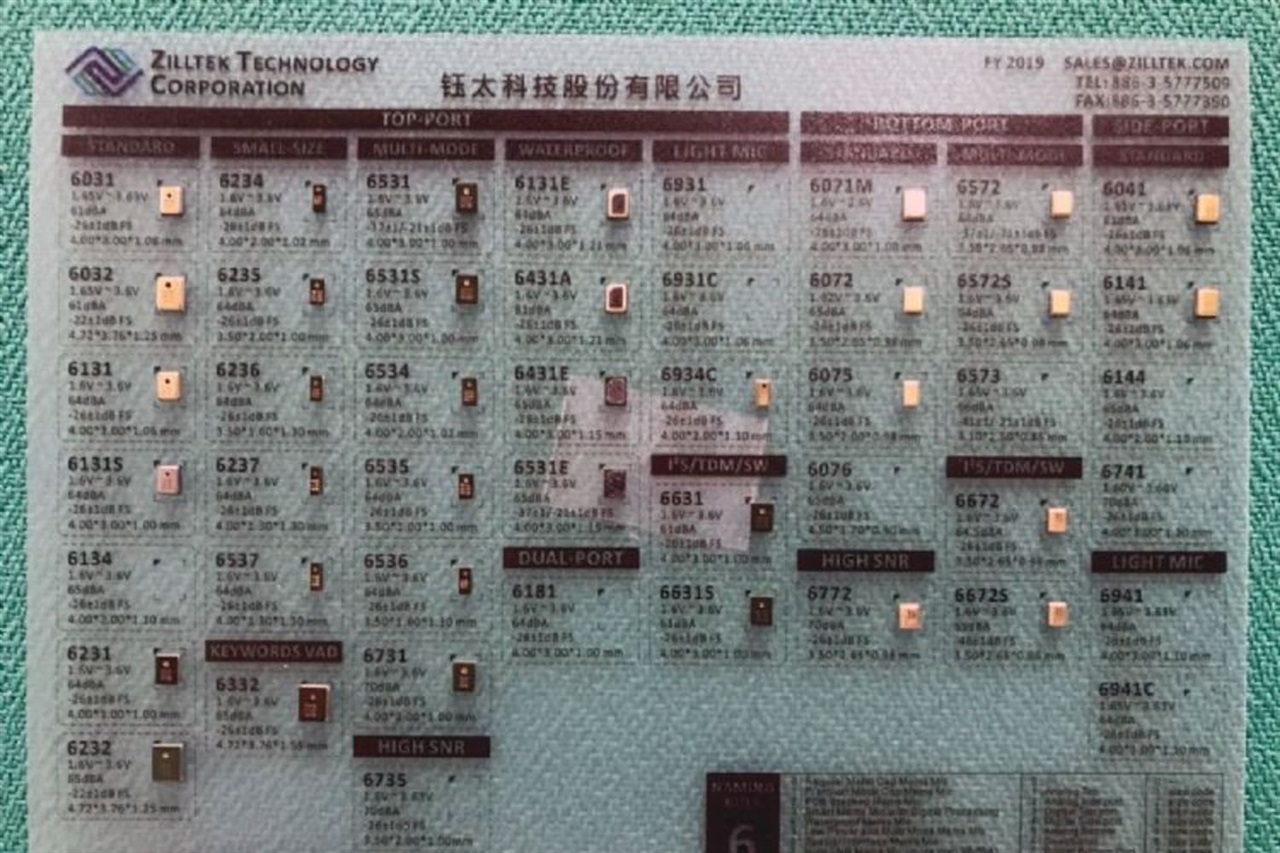
When a component supplier registers steady growth from PCs, cars, and hearing aids, the instinct is to read it as an industry story. But look closer: ZillTek—a Taiwanese company specializing in MEMS microphones, audio codecs, and voice-capture chips—is telling us something deeper. It’s charting the silent shift toward AI that lives on devices, far from data centers.
Sustained demand across three diverse markets shows that voice interfaces are no longer a smartphone niche. The PC, for years dismissed as a legacy productivity tool, has become a collaboration terminal where audio capture quality determines the effectiveness of virtual meetings and embedded assistants. In automotive, the cabin is turning into a conversational space where voice commands handle navigation, climate, and entertainment, requiring components robust against ambient noise. Hearing aids, meanwhile, are no longer mere amplifiers: they are edge devices processing sound in real time, applying noise reduction and environmental adaptation algorithms that increasingly rely on neural networks.
For anyone watching the on-premise AI landscape, this picture is packed with meaning. In each of these cases, voice processing cannot afford the round-trip latency of the cloud. A car command must execute instantly; a hearing aid cannot depend on connectivity; a laptop in a video call cannot degrade if the network is unstable. Architectural pressure thus pushes inference toward locally executed quantized models, running on hardware with reduced thermal and power footprints.
ZillTek doesn’t make accelerators or NPUs—its role is upstream, in the sensor chain. Yet its revenue trend unequivocally signals that the number of digital listening points is expanding rapidly. The more smart microphones get installed, the larger the installed base of devices demanding local processing for privacy and responsiveness. A first-order consequence follows: demand for edge inference silicon (from microcontrollers with integrated accelerators to SoCs with NPUs) is bound to strengthen, reducing per-unit cost and making on-premise accessible to more use cases.
Read between the lines, and a second-order effect on the Large Language Model market emerges. While full-scale LLMs remain massive, the fragmentation of voice interactions pushes toward specialized, tinyML models that can run locally without server GPUs. This shifts incentives: instead of shipping everything to a hyperscaler, device designers prefer to embed on-device models that capture and process data without ever leaving the physical perimeter. For cloud AI vendors, it means a growing slice of inference moves beyond their reach; for system integrators and enterprises evaluating private deployments, it’s a cue to invest in hybrid architectures where most work stays local.
Data sovereignty—often confined to enterprise servers—finds a concrete anchor here. A connected hearing aid or a voice-controlled car generates sensitive data: private conversations, locations, habits. Local processing then becomes not just a technical choice but a compliance necessity (think GDPR). ZillTek’s growth thus reflects an ecosystem that, brick by brick, builds the foundations for a distributed model where the cloud serves as an orchestration layer, not the sole executor.
Challenges remain: aggressive quantization degrades quality, updating models across millions of edge nodes is complex, and hardware fragmentation makes standardization hard. Yet the trend emerging from ZillTek’s numbers—dry and unflashy as they are—adds a piece to the thesis that AI’s future isn’t only in the cloud, but scattered across every device we now call “peripheral” and that tomorrow will be an intelligent node in a distributed inference network.
What looks like marginal news, in short, may be one of the most honest indicators of where we’re heading.






💬 Comments (0)
🔒 Log in or register to comment on articles.
No comments yet. Be the first to comment!