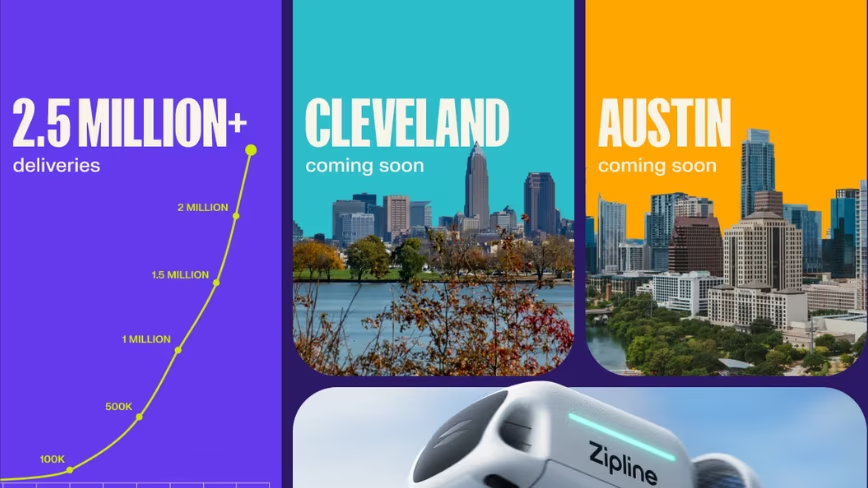
Zipline closed the first half of 2026 with a metric that would humble any traditional logistics network: the number of businesses offering delivery through its app grew 13 times in six months. The autonomous drone company has now completed more than 2.5 million commercial deliveries, including one million in the last year alone, and claims to operate more flights per day than major US airlines. What makes these figures even more significant is the new partnership with Cleveland Clinic for healthcare delivery and the strategic hiring of veterans from Tesla and Waymo to lead scale-up efforts. This is not a standard business expansion; it is a structural signal for those building and evaluating on-premise computing architectures dedicated to autonomous automation, especially in sectors where data sovereignty and latency become non-negotiable constraints.
Onboard autonomy and health privacy: the edge push
Zipline’s drones must take off, navigate, and avoid obstacles in real time with zero network latency. This means inference for perception and flight planning models runs entirely on-device, on embedded hardware that cannot rely on remote data centers. In healthcare, the problem intensifies: transported materials—biological samples, medication, blood products—carry sensitive patient information. Even if the payload’s content is not processed by the drone, the logistics control, telemetry, and routing data must remain under the operator’s domain and comply with regulations akin to HIPAA or GDPR. On-premise processing at local distribution hubs therefore becomes a hard requirement, and on-edge processing aboard the drone completes an architecture that minimizes data flows to the outside world.
The Tesla-Waymo legacy and the maturity of distributed AI
Hiring key figures from companies that have industrialized on-road autonomy is no cosmetic move. Tesla and Waymo spent years tackling the challenge of running complex neural networks on centralized onboard computers, with periodic updates and redundant architectures for safety. By bringing this know-how into the skies, Zipline is implicitly signaling that the prototype phase is over: it is moving to large-scale production where the reliability of on-device inference becomes a competitive differentiator. The daily flight volume, exceeding that of traditional airlines, is empirical proof that distributed AI inference has reached operational maturity in high-stakes contexts. Compared to the cloud-centric narrative pushed by some vendors, the choice here is the opposite: autonomy’s state resides on the vehicle, and the cloud only serves orchestration and data aggregation, not real-time control.
Implications for the edge computing supply chain
This trajectory has long-term consequences for AI hardware. Demand for low-power, high-performance embedded accelerators grows not only for robotics but also for drone fleets in regulated domains like healthcare. Edge AI chip manufacturers—from NVIDIA’s Jetson line to FPGA- or ASIC-based solutions—face a market that no longer wants just prototypes but hundreds of thousands of units with multi-year lifecycles, certifications, and operational continuity guarantees. For organizations evaluating on-premise deployment of autonomous fleets, the TCO calculation must include not just the drone cost but the entire hardware maintenance pipeline, model update workflow management in potentially air-gapped environments, and the resilience of local inference systems. Zipline, with its volume, offers a concrete benchmark of what it means to move from lab to mass production in this sector, tilting the balance toward increasingly distributed architectures that rely less on external hyperscalers. Ultimately, the success of autonomous healthcare delivery does not only tell a logistics story: it redraws the computing hierarchies that will underpin automation in the next decade.







💬 Comments (0)
🔒 Log in or register to comment on articles.
No comments yet. Be the first to comment!