Topic / Trend Rising

AI Safety and Real-World Reliability Under Scrutiny

From medical misdiagnosis to biased reasoning, incidents where AI fails or causes harm are fueling debates about guardrails, transparency, and the limits of current safety measures.

Detected: 2026-07-24 · Updated: 2026-07-24

Related Coverage

2026-07-24 ArXiv cs.AI

LLM Watermarking in Medicine: How Traceability Degrades Clinical Accuracy

A new study shows that watermarks on medical LLMs induce hallucinations, lexical corruption, and diagnostic errors. Standard benchmarks fail to catch these failures, creating a false sense of safety. The issue is critical for on-premise healthcare de...

#LLM On-Premise #Fine-Tuning #DevOps
2026-07-23 ArXiv cs.CL

Cumulative Risk in LLM Dialogues: Safety Goes Stateful

Today's guardrails evaluate each prompt-response pair in isolation, overlooking risks that emerge only over multi-turn dialogues. A new framework tracks semantic drift and information accumulation, with direct implications for on-premise deployment a...

#LLM On-Premise #DevOps
2026-07-22 ArXiv cs.AI

ECE: Selective fact-checking for LLMs, abstention as a safety shield

The Evidence Chain Evaluation (ECE) framework lets LLMs abstain from judgment when evidence is weak, avoiding forced verdicts. On ECE-Bench, it achieves 97.8% selective accuracy on answered claims while deferring 6 out of 95 cases, mostly from low-re...

#LLM On-Premise
2026-07-20 MIT Technology Review

LLMs Don’t Just Inherit Biases—They Invent Their Own

New experiments show that models like o3 and R1 develop stronger occupational stereotypes than humans after just a few simulated hires. The paradox: the most capable models are also the most biased, and telling them to be fair isn’t enough—they need ...

#LLM On-Premise #Fine-Tuning #DevOps
2026-07-19 The Next Web

AI advice makes you three times less accurate but twice as confident

A joint study by French and Italian universities shows that access to AI advice collapses willingness to say 'I don't know' from 44% to 3%, drops accuracy from 27% to 9%, and inflates confidence from 30% to 76%. These figures expose a structural vuln...

#Hardware #LLM On-Premise #Fine-Tuning

2026-07-18 LocalLLaMA

catmind-1.2b: When the LLM Thinks About Cats Instead of Your Prompt

An experiment turns a reasoning model into a cat-story narrator, cratering accuracy by over 50 percentage points. A mere game? It raises real questions about fine-tuning stability, the use of thinking tokens, and what it means to trust a self-hosted ...

#Hardware #LLM On-Premise #Fine-Tuning
2026-07-18 Ars Technica AI

AI in Prior Authorization: Help or Hindrance? Survey Shows Doctors' Alarm

A 2025 American Medical Association survey finds 61% of physicians worry AI will worsen unjustified denials in health insurance prior authorization. While AI could speed up approvals, resistance is mounting, raising crucial questions about transparen...

#LLM On-Premise #Fine-Tuning #DevOps
2026-07-17 The Next Web

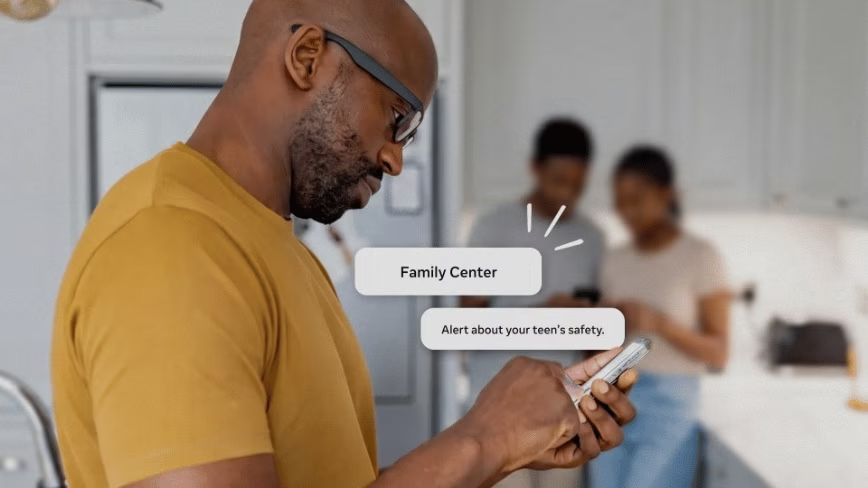
Meta will alert parents to teens' self-harm chats with its AI

Meta introduces notifications for parents when a teenager discusses suicide or self-harm with its AI chatbot. Already live in the US, UK, Australia, and Canada, the feature uses Instagram's supervision tools. The move prompts questions about AI trust...

#LLM On-Premise #DevOps
← Back to All Topics