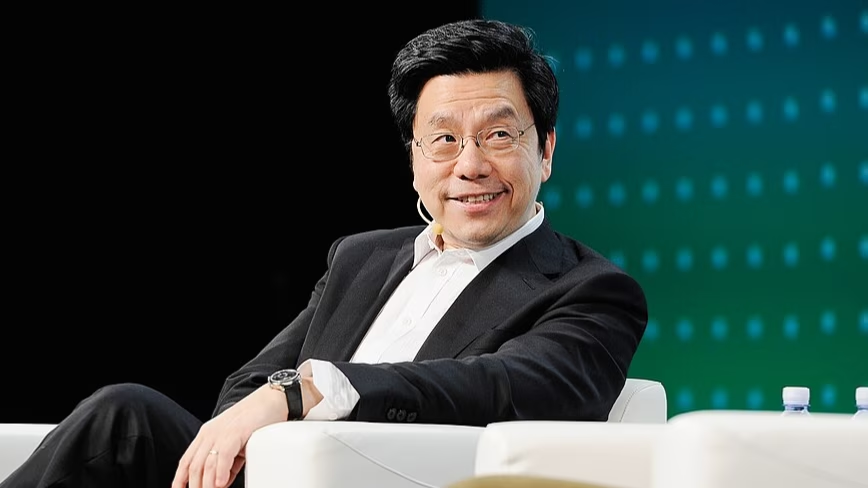
When a name like Kai-Fu Lee decides to stop building AI models and start selling enterprise data infrastructure instead, it’s not just a footnote. His company, 01.ai, is raising a pre-IPO round and targeting a Hong Kong listing in 2027. The news, shared with Bloomberg at the World AI Conference in Shanghai, coincides with the unwinding of its offshore holding structure — the same prerequisite Moonshot dismantled in May to clear its path to Hong Kong’s stock exchange.
This is not simply a financial operation. It’s a statement that the real value today lies not in the race for ever-larger models, but in the scaffolding that lets businesses handle data and inference on their own terms. For anyone who has followed Lee’s career — former head of Google China, investor, public intellectual — the pivot is emblematic: from creator of intelligence to provider of digital sovereignty.
The backdrop: from Moonshot to 01.ai, the mandatory path to Hong Kong
Unwinding an offshore structure is a technical step loaded with meaning. Hong Kong requires listed companies to be domiciled locally or to have a compatible legal structure. For Chinese startups born with holding entities in the Cayman Islands, stripping away that corporate veil means accepting more direct oversight from mainland regulators, but it also opens the door to an international financial hub without the restrictions of a US IPO. Moonshot led the way; 01.ai is following suit, and other AI firms will likely do the same.
Yet there’s a difference. Moonshot still develops models. 01.ai has already pivoted, publicly stating it sells enterprise data infrastructure. This is not a tactical concession — it’s a strategic repositioning aimed squarely at companies that need to run AI workloads without handing their data over to third parties.
Infrastructure first: the paradox of the model race
The AI industry has spent years chasing parameter counts and benchmark scores. But on the ground, enterprises face more mundane problems: where to run the model, how to handle latency, how to comply with data residency rules. 01.ai’s move from training models to supplying the infrastructure for inference and fine-tuning answers a real question: who’s going to pay for models if there are no pipelines to put them into production?
In China, where regulatory pressure pushes firms toward local data control, the value of on-premise — or at least fully governable environments — increases daily. It’s no coincidence that a veteran like Lee is taking this route. It’s less flashy than a record-breaking LLM, but probably more profitable, because it addresses the daily headache of every CTO at a mid-sized or large enterprise.
For teams evaluating on-premise deployment, 01.ai’s pivot adds a piece to the puzzle: data infrastructure is no longer a commodity market; it’s the battleground for sovereignty. And when a player of Lee’s stature chooses to plant his flag there, it signals that demand is concrete enough to support a stock market exit.
Winners and losers in this transition
In the short term, the beneficiaries are hardware and system builders already tuned to enterprise needs: high-performance storage, low-latency networking, and orchestration software stacks. System integrators who guide companies from proof of concept to production will also get a boost.
Losers are the AI startups that haven’t yet found a path to sustainability and remain focused solely on model research. Without a clear enterprise revenue pipeline, they risk drifting in a dilution limbo. Lee’s move shows that the market is asking for delivery, not just papers.
Ultimately, 01.ai isn’t just heading to Hong Kong. It’s buying a ticket for a different journey than the one of the past two years: less hype, more fundamentals. For those who debate every day where to run their AI workloads, that matters more than yet another open-source checkpoint.







💬 Comments (0)
🔒 Log in or register to comment on articles.
No comments yet. Be the first to comment!