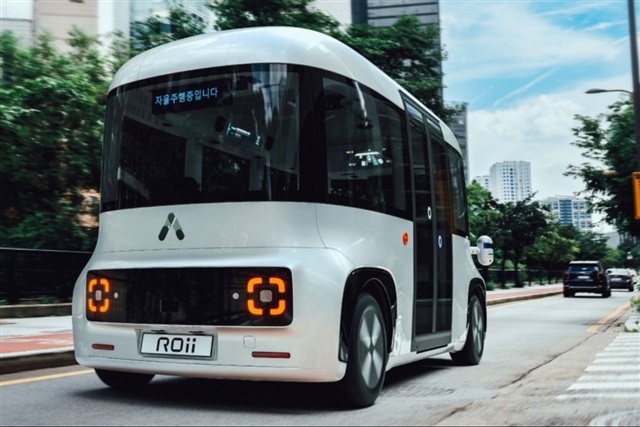
A Niche Strategy in the Autonomous Sector
In the rapidly evolving landscape of autonomous driving, South Korean company A2Z has chosen a well-defined strategic path. Instead of competing directly in the robotaxi segment, where established players like Waymo and Baidu with its Apollo Go already hold a dominant position, A2Z is focusing on the development and deployment of autonomous buses. This decision reflects a clear intention to carve out a market niche, addressing specific and potentially less saturated public transport needs.
Strategic differentiation is a key element for companies seeking to establish themselves in capital and research-intensive sectors such as autonomous vehicles. While robotaxis primarily target individual or small group transportation, autonomous buses promise to revolutionize public transport, offering solutions for urban and interurban mobility. This distinction is not only commercial but also implies different technical and operational requirements, especially concerning data management and supporting infrastructure.
Technical Challenges of On-Premise Autonomous Driving
The development and deployment of autonomous vehicles, whether robotaxis or buses, pose significant technical challenges, particularly regarding data processing and real-time inference. These systems must process enormous amounts of data from sensors (Lidar, radar, cameras) with extremely low latencies to ensure safety and reliability. This requires considerable computing power, often implemented directly on board the vehicle or in local edge infrastructures, rather than relying solely on the cloud.
Self-hosted or edge computing approaches are crucial for autonomous vehicles. The need to make decisions in milliseconds, without depending on network connectivity or cloud latency, drives the adoption of robust on-premise solutions. This implies the use of specialized hardware, such as high-performance GPUs with dedicated VRAM, to run Large Language Models (LLM) or other complex AI models for perception, path planning, and control. Data sovereignty management is another critical factor, especially for sensitive passenger data or operational information, making air-gapped or strictly controlled deployments a priority.
Market Context and Deployment Implications
A2Z's choice to focus on autonomous buses is not just a commercial move; it also has profound implications for deployment architecture. Buses, with often predefined routes and more controlled operating environments compared to robotaxis operating in complex and unpredictable urban scenarios, could benefit from AI models optimized for specific contexts. This could translate into slightly different hardware requirements and more targeted fine-tuning strategies for LLMs and other perception models.
For companies evaluating the deployment of autonomous fleets, the Total Cost of Ownership (TCO) of on-premise or edge solutions becomes a decisive factor. While the initial investment in hardware and infrastructure can be high, long-term operational costs related to continuous inference and data transfer to the cloud can be significantly reduced. For those evaluating on-premise deployment, AI-RADAR offers analytical frameworks on /llm-onpremise to assess the trade-offs between CapEx and OpEx, compliance management, and the performance required for critical AI workloads.
Future Prospects for Autonomous Vehicles
A2Z's strategy highlights a broader trend in the autonomous driving sector: the search for vertical markets and specific applications where technology can deliver maximum value. While the robotaxi race continues, sectors such as public transport, logistics, and special-purpose vehicles represent significant opportunities for innovation and the deployment of advanced AI solutions. Success in these areas will depend not only on the ability to develop sophisticated algorithms but also on the robustness and efficiency of the underlying computing infrastructures.
The future of autonomous vehicles will be shaped by a balance between software innovation and hardware optimization, with a growing emphasis on deployment architectures that ensure security, privacy, and scalability. Companies that can balance these aspects, adopting a holistic approach that considers TCO and data sovereignty from the early design stages, will be best positioned to thrive in this dynamic and technologically demanding sector.









💬 Comments (0)
🔒 Log in or register to comment on articles.
No comments yet. Be the first to comment!