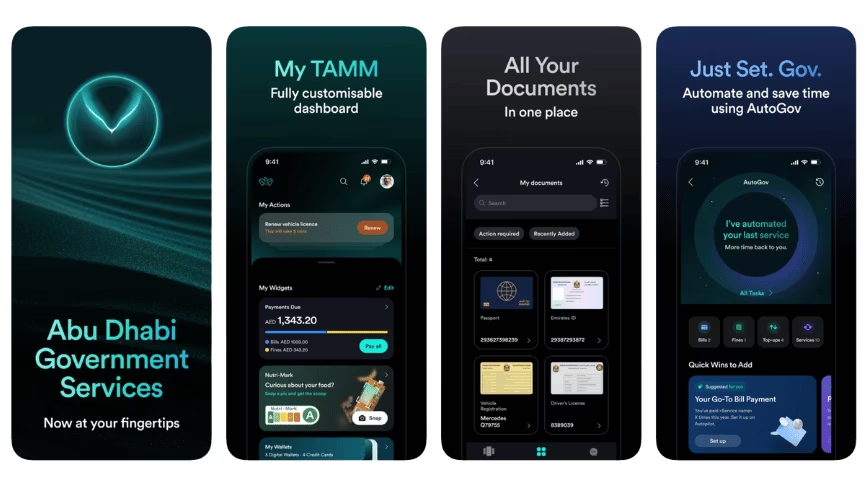
Renew your ID, book a medical appointment, pay a parking fine—all from a single app, sometimes without even having to ask: the system already knows what you need and acts on its own. This is not a future scenario but what is happening today in Abu Dhabi, where artificial intelligence is not a regulatory talking point but the operational backbone of the entire government machine.
The news, reported by The Next Web, feels like an inflection point: while most governments are still putting together a first draft of a national AI strategy, the capital of the United Arab Emirates has put an AI-native service ecosystem into production. And it did so quietly, without the fanfare that often accompanies public initiatives in the West.
What “AI-native government” really means
This is not just about digitizing procedures. An AI-native system is built with intelligence embedded in its decision-making core, not bolted on later as a conversational interface. The app cited in the source does more than respond to commands—it cross-references identity records, deadlines, mobility patterns, and transaction histories to proactively activate services. It’s a paradigm shift comparable to moving from desktop applications to cloud computing.
To run reliably and securely on a government scale, such an architecture imposes strict constraints. Citizen data—health, identity, financial—must reside under direct state control. Public cloud and third-party APIs are not enough, especially when the information is sensitive and decision latency can have immediate administrative impact. That’s why, even though the source provides no technical details, Abu Dhabi’s model signals a commitment to on-premise or tightly governed hybrid deployment.
The hardware you don’t see (but matters)
No press release lists GPUs, inference nodes, or frameworks. But infrastructure capable of orchestrating millions of predictive transactions daily, with low latency and high availability, demands dedicated local or edge compute. It is not unreasonable to envision server clusters equipped with cutting-edge accelerators, optimized for inference pipelines on models fine-tuned on government data. In such a scenario, quantization and fine-tuning techniques become critical levers to balance performance and cost, while VRAM and memory bandwidth determine whether the workload can be sustained.
This positions Abu Dhabi as an implicit testbed for the on-premise AI industry. If the model works over the long term—without privacy incidents or performance bottlenecks—it sets a precedent that other governments, from GDPR-bound Europe to interventionist Asia, may feel compelled to follow, boosting demand for specialized hardware and self-hosted software stacks.
Winners and losers
In the short term, the winners are AI infrastructure providers that can offer turnkey solutions for the public sector, with guarantees of sovereignty and auditability. Hyperscale cloud providers could be left on the sidelines of this segment unless they can demonstrate true data isolation in dedicated, certifiable regions. Those who lose, at least temporarily, are ecosystems that have bet everything on centralized AI delegated to third parties, because Abu Dhabi’s story suggests that citizen trust also hinges on physical control of the hardware.
The second-order effect is more subtle: once a government proves that predictive AI works at a national scale, political inertia drives an expansion of services, increasing compute needs and dependence on internally updatable stacks. This becomes a flywheel for investment in research on LLMs tailored to administrative domains and on compression techniques that let them run without unattainable GPU requirements.
Finally, there is a third-order implication touching the geopolitical balance of technology. When a player like the UAE builds an AI-native government without depending exclusively on American or Chinese vendors, it asserts a model of technological autonomy that can set an example for regions with similar financial resources and ambitions, reshaping supply chains and power dynamics in the global AI market.







💬 Comments (0)
🔒 Log in or register to comment on articles.
No comments yet. Be the first to comment!