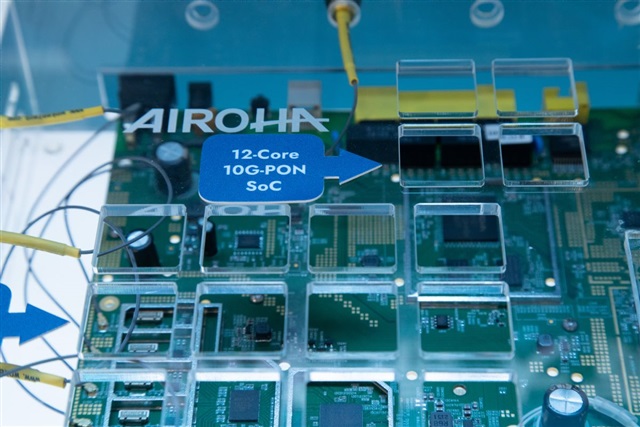
Airoha's Commitment to AI Networking
Airoha, a strategic unit of MediaTek, has announced an acceleration of its efforts in the artificial intelligence networking sector. The company aims to achieve "triple optical growth," an objective that underscores the increasing demand for high-performance connectivity solutions to support the expansion of AI workloads.
This orientation reflects a broader market trend, where the ability to process and transfer large volumes of data quickly and efficiently has become a critical factor for the development and deployment of Large Language Models (LLM) and other artificial intelligence applications. Networking, often underestimated, emerges as a fundamental pillar for the effectiveness of modern AI infrastructures.
The Crucial Role of Optical Networking for On-Premise AI
For on-premise AI deployments, the network represents a potential bottleneck if not adequately sized. Training and inference of LLMs require high throughput and extremely low latency to ensure that Graphics Processing Units (GPUs) can communicate effectively with each other and with storage systems.
Optical networking solutions, based on fiber, offer significant advantages over traditional copper connections, especially over longer distances and for higher speeds. These technologies are essential for interconnecting GPU clusters, servers, and storage arrays within a data center, ensuring that data can flow seamlessly and that the performance of AI models is not compromised. The ability to handle large batch sizes and maintain a high number of tokens per second directly depends on the robustness and speed of the network infrastructure.
Implications for Infrastructure and TCO
Networking choices have a profound impact on the overall AI infrastructure design and the Total Cost of Ownership (TCO). Investing in high-speed optical solutions, while potentially involving higher initial CapEx for cables, switches, and network cards, can lead to lower OpEx in the long run due to greater energy efficiency and reduced maintenance needs.
Scalability is another key factor: a well-designed optical network infrastructure can support future expansions without requiring a complete redesign. For those evaluating on-premise deployments, analyzing the TCO of networking solutions is fundamental. AI-RADAR offers analytical frameworks on /llm-onpremise to assess these trade-offs, considering not only the initial cost but also the long-term impact on performance, management, and, crucially, data sovereignty and compliance. In air-gapped or self-hosted environments, a robust and controlled network infrastructure is indispensable for maintaining information security and confidentiality.
Future Prospects and Challenges for AI Adoption
Airoha's focus on optical growth in AI networking highlights a clear direction for the industry. With the continuous evolution of network standards, such as new generations of Ethernet and InfiniBand, the ability to integrate and manage these technologies in complex environments will become increasingly critical. Companies aiming to fully leverage the potential of artificial intelligence must consider networking as a strategic element, not just a cost.
A resilient and high-performance network infrastructure is the pillar upon which large-scale AI adoption in enterprise contexts is built, ensuring that promises of efficiency and innovation can be met. The challenge will be to balance speed and capacity requirements with deployment complexity and budget constraints, an equilibrium that Airoha and other industry players are striving to address with innovative solutions.









💬 Comments (0)
🔒 Log in or register to comment on articles.
No comments yet. Be the first to comment!