
Airoha and the Push Towards Distributed AI
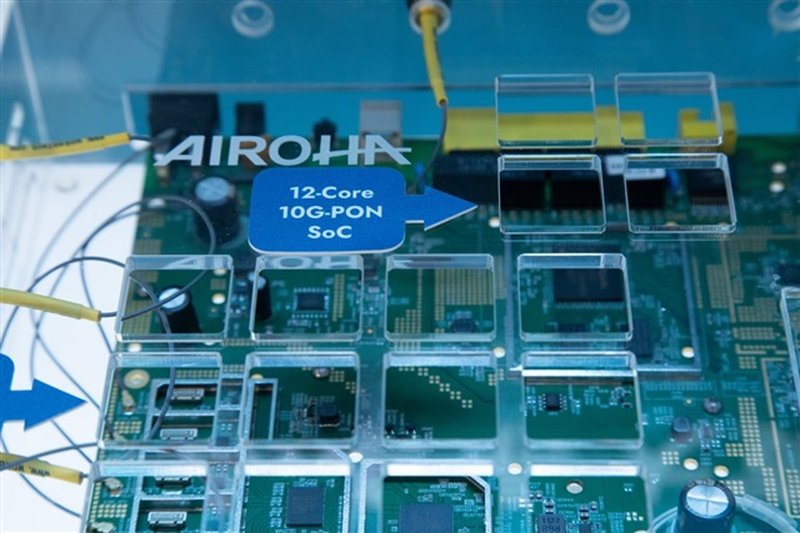
Airoha, a prominent semiconductor company, is consolidating its strategy, shifting its focus more distinctly towards networking technologies and edge artificial intelligence. This repositioning highlights a clear direction towards solutions that enable data processing and AI model execution directly on devices or in close proximity to the data source, rather than relying solely on centralized cloud infrastructures.
Airoha's decision reflects a significant market trend where the ability to process information in real-time with minimal latency becomes a critical factor. For businesses, this translates into greater control over data and a potential reduction in long-term operational costs, fundamental aspects for those carefully evaluating deployment architectures.
The Value of Edge Artificial Intelligence
Edge AI represents a processing paradigm where inference workloads for Large Language Models (LLM) or other machine learning models are executed on local hardware, such as self-hosted servers, IoT devices, or industrial gateways. The advantages are manifold: firstly, a drastic reduction in latency, as data does not need to travel to a remote data center for processing. This is crucial for applications in sectors like robotics, smart manufacturing, or video surveillance, where real-time decisions are imperative.
Furthermore, edge processing strengthens data sovereignty. Sensitive information can remain within corporate or national boundaries, facilitating compliance with regulations like GDPR and reducing security risks associated with transferring data over external networks. For organizations operating in air-gapped environments or with stringent compliance requirements, edge AI is not just an option, but a strategic necessity.
Implications for Infrastructure and TCO
Adopting edge AI involves specific infrastructural considerations. It requires hardware optimized for inference, often with VRAM and compute capability requirements balanced for operation in environments with space, power, and cooling constraints. Companies must carefully evaluate the Total Cost of Ownership (TCO), which includes not only the initial investment (CapEx) in silicon and servers but also operational costs (OpEx) related to energy, maintenance, and management.
An on-premise or hybrid deployment, supported by efficient networking solutions for managing data traffic between the edge and core, can offer a more advantageous TCO in the long run compared to an entirely cloud-based infrastructure, especially for predictable, high-volume workloads. Airoha's ability to provide components for networking and edge AI can therefore simplify the development and deployment pipeline for companies building these architectures.
Strategic Outlook and Trade-offs
Airoha's move underscores the increasing maturity of the distributed AI market. While edge processing offers benefits in terms of performance, security, and control, it also presents trade-offs. Managing a distributed infrastructure can be more complex and require specific technical skills compared to relying on managed cloud services. However, for organizations prioritizing data sovereignty and hardware customization, investing in self-hosted and edge solutions is strategic.
For those evaluating on-premise deployments for LLM and AI workloads, analytical frameworks that AI-RADAR explores at /llm-onpremise exist to compare initial costs with long-term benefits, flexibility, and security. Airoha's orientation fits perfectly into this context, offering key components to build a resilient and controlled AI infrastructure.







💬 Comments (0)
🔒 Log in or register to comment on articles.
No comments yet. Be the first to comment!