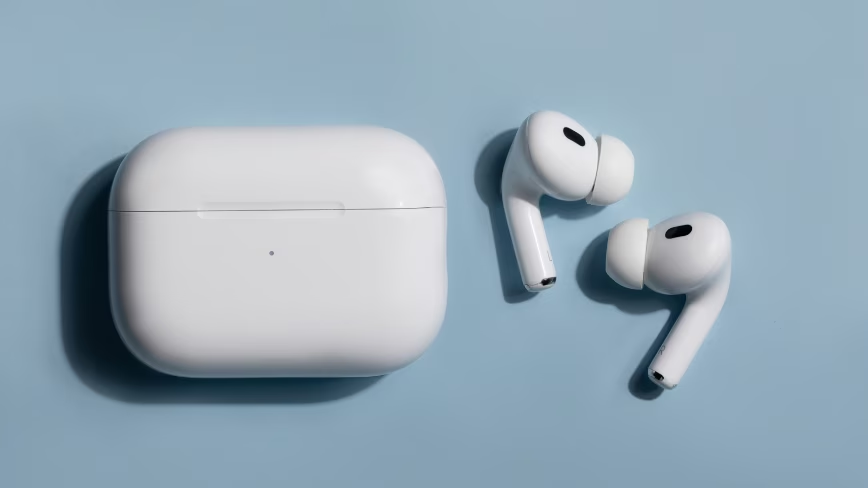
CNET Labs’ testing of the AirPods Pro 3 heart rate sensor revealed an average error of just 1.67% compared to the Polar H10 chest strap, a medical-grade reference. That makes the earbuds the second most accurate consumer heart rate device the publication has ever measured, behind only the Apple Watch Series 11 at 0.98% error.
The news, reported by The Next Web, marks a turning point for true wireless earbuds, which have long been seen as little more than audio accessories. Apple has consistently signaled its ambition to turn AirPods into a health platform, and these figures give concrete weight to that vision.
Why an optical sensor in the ear works so well
The measurement relies on a miniaturized photoplethysmography (PPG) sensor that uses green LEDs and photodiodes to detect blood volume changes inside the ear canal. Compared to the wrist, the ear benefits from fewer motion artifacts and more stable vascularization – two anatomical advantages that partly explain the achieved accuracy. The engineering challenge is still significant: light must penetrate the skin, filter out ambient noise, and compensate for micromovements during physical activity.
The Polar H10 chest strap, a medical-grade benchmark, measures the heart’s electrical activity (ECG) in direct contact with the skin, virtually eliminating interference. The AirPods Pro 3’s 1.67% deviation should therefore be read as a remarkable leap toward a method that is more invasive and less convenient, yet fundamentally different.
From lab curiosity to strategic posture
For those working with data infrastructure, this result goes beyond a lab finding. Having clinically reliable sensors inside mass-market wearables changes the nature of health information flows. Apple has built an ecosystem where biometric data processing largely occurs on-device, reducing cloud dependency and strengthening privacy. AirPods, which already communicate with iPhone and Apple Watch, could become an additional local node for data collection and analysis, without the need to transfer sensitive information to external servers.
This approach echoes the data sovereignty and on-premise computing logic that AI-RADAR regularly explores: while earbuds are not servers, the architectural choice to keep personal data under user control – via local processing – follows the same philosophy as organizations that choose self-hosted Large Language Models to avoid compliance risks and hidden operational costs.
Open prospects and limitations
CNET’s tests do not detail motion protocols, skin types, or environmental conditions – all variables that can influence optical readings. Moreover, it remains unclear whether Apple will pursue FDA validation for this feature as a medical device, or how it will integrate with the Health and Fitness+ apps. Compared to the Apple Watch, AirPods lack a display and a battery designed for continuous monitoring, yet they compensate with a more discreet form factor and an already established daily usage pattern.
The convergence of audio and biometrics is not an isolated experiment: other companies are exploring in-ear sensors to detect temperature, posture, and even glucose levels. Against this backdrop, the AirPods Pro 3 numbers pressure competitors and suggest that the future of digital health will increasingly run through ear-worn devices, managed by hybrid edge-cloud architectures, with privacy as a key differentiator.
The path is drawn: the challenge now is to ensure that accuracy translates into reliable clinical decisions, without succumbing to the temptation of collecting more data than is truly needed.









💬 Comments (0)
🔒 Log in or register to comment on articles.
No comments yet. Be the first to comment!