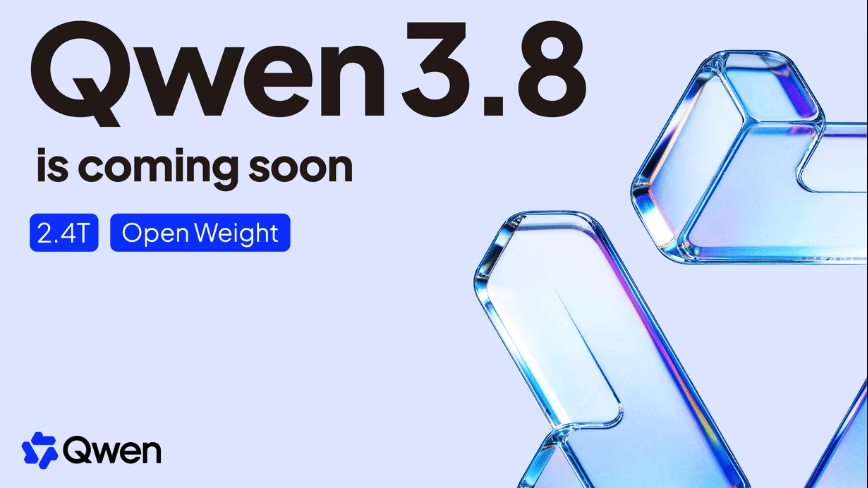
Within days, two Chinese labs have fired off unverifiable shots. After DeepSeek’s disruption, Alibaba answered with Qwen3.8, presented at the World Artificial Intelligence Conference in Shanghai as the second most powerful language model on Earth. The Qwen team posted on X that Qwen3.8 “trails only one model.” The problem: there is not a shred of proof.
No weights were released, no public benchmarks, no technical report. Just a staged demo and the echo of a rivalry that, for now, looks more like a press-release war than an advancement of the art. That’s no small detail for anyone working with LLMs on-premise.
The showcase with no glass
Those choosing a Large Language Model for self-hosted environments – whether it’s a bank, a hospital, or a manufacturer – aren’t buying hype. They’re buying guarantees: latency under load, VRAM footprint at different quantization levels, real throughput on proprietary hardware, context windows manageable without memory saturation. All that requires measurable numbers, not proclamations.
Alibaba’s move follows a familiar script. Models are announced with bombastic labels (“revolutionary,” “superhuman”) and then released, at best, weeks later with truncated weights, ambiguous licenses, and zero independent evaluations. For on-premise deployment, that’s a dead end: you can’t do due diligence on a ghost.
The issue isn’t whether Qwen3.8 actually trails only GPT-4o or Claude 3.5 Sonnet. The issue is that a lack of transparency shifts the burden of verification onto the user, forcing reverse engineering through DIY benchmarks, with unforeseen costs and the risk of regression in production.
Who wins and who loses
The winners are vendors who feed the narrative of supremacy, perhaps to attract capital or sway government procurement decisions. The losers are organizations seeking data sovereignty and reliable automation without depending on opaque cloud APIs. For them, a model with unknown training data, long-prompt performance, and energy consumption is a technical debt waiting to explode.
And there’s a second-order consequence: when market leaders normalize announcement without evidence, they erode trust across the entire open and semi-open ecosystem. Teams that need to convince the CISO or CFO to invest in GPUs for local inference are left without verifiable arguments, while the vendor’s marketing department waves self-proclaimed rankings.
Structurally, it’s a signal that model competition is shifting toward perception rather than reproducibility – a problem for anyone planning to run an LLM on their own infrastructure, where total cost of ownership is measured in electricity, maintenance cycles, and mean time between fallbacks.
The litmus test
For those tracking the sector, the discriminant is simple: the day Qwen3.8 releases weights, inference parameters, and a public evaluation harness, we can discuss it as a real option for on-premise environments. Until then, it’s just a headline on X.
In the AI-RADAR ecosystem, where we analyze local stacks and deployment decisions, the reflex is always the same: trust the metrics you can run in your own data center, not the ones you read in a tweet. Sovereignty includes verifiability.


💬 Comments (0)
🔒 Log in or register to comment on articles.
No comments yet. Be the first to comment!