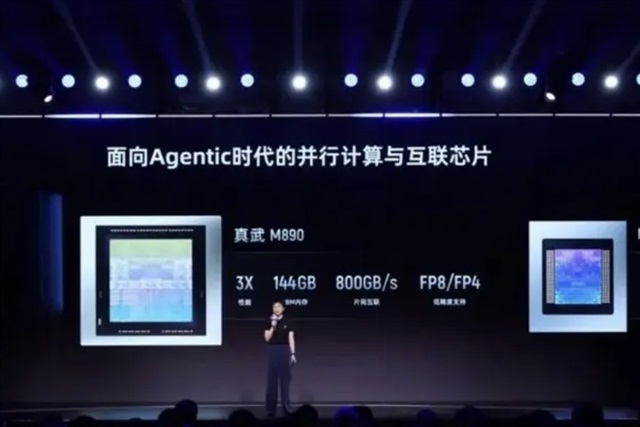
Alibaba T-Head Bolsters AI Infrastructure with Zhenwu M890
Alibaba's Strategic Commitment to AI Silicon
Alibaba T-Head, the semiconductor division of the Chinese tech giant, is significantly intensifying its commitment to developing dedicated artificial intelligence infrastructure. This strategy materializes with the introduction of the Zhenwu M890, a new component designed to strengthen the computing capabilities required to handle growing AI workloads. Alibaba's move underscores a broader trend in the technology sector: the increasing importance of proprietary and optimized hardware solutions for specific AI needs, particularly for Large Language Models (LLMs) and generative AI.
The investment in custom silicon reflects the understanding that efficiency and performance in the AI era increasingly depend on vertical integration between software and hardware. For companies operating with massive data volumes and complex models, having a robust and tailored foundational infrastructure can represent a crucial competitive advantage, directly impacting the Total Cost of Ownership (TCO) and the ability to innovate rapidly.
The AI Infrastructure Landscape and Current Challenges
Modern AI infrastructure demands a sophisticated combination of computing power, high-bandwidth memory, and low-latency connectivity. Components like the Zhenwu M890 fit into an ecosystem where the demand for resources for LLM training and inference is constantly growing. Key challenges for enterprises include managing VRAM for increasingly larger models, optimizing throughput to process millions of tokens per second, and reducing latency for real-time applications.
The choice between on-premise, cloud, or a hybrid deployment approach is a complex strategic decision for CTOs and infrastructure architects. Cloud solutions offer scalability and flexibility but can entail high operational costs and raise data sovereignty concerns. Conversely, a self-hosted infrastructure, powered by dedicated hardware like that proposed by T-Head, can offer greater control, security, and, in the long term, a more advantageous TCO, especially for predictable and intensive workloads.
Implications for Deployment and Data Sovereignty
The introduction of dedicated chips like the Zhenwu M890 has direct implications for enterprise deployment strategies. For organizations prioritizing data sovereignty, regulatory compliance (such as GDPR), or operating in air-gapped environments, adopting proprietary hardware and building an on-premise infrastructure are becoming increasingly attractive options. This approach allows for granular control over the entire AI pipeline, from data management to model inference, ensuring that sensitive information remains within corporate boundaries.
The ability to optimize hardware for specific workload requirements, such as quantization to reduce memory requirements or the implementation of parallelism techniques, is a key factor. Although specific technical details of the Zhenwu M890 have not been disclosed, its existence signals a focus on solutions that can offer targeted efficiency and performance, fundamental aspects for those evaluating alternatives to the public cloud. For those considering on-premise deployments, AI-RADAR offers analytical frameworks on /llm-onpremise to evaluate trade-offs between costs, performance, and control.
Future Prospects in the AI Silicon Market
Alibaba T-Head's initiative is part of a global trend seeing more and more technology companies investing in the development of custom silicon for AI. From Google with its TPUs to Meta with its internal efforts, the race for optimized hardware is an indicator of the maturity and pervasiveness of artificial intelligence. This competition stimulates innovation, leading to increasingly powerful and efficient chips capable of handling LLM models with billions of parameters.
The AI silicon market is set to evolve rapidly, with a growing emphasis on solutions that not only offer raw computing power but also energy efficiency, security, and ease of integration into existing infrastructure stacks. For businesses, choosing the right hardware will become a distinguishing element in their ability to fully leverage the potential of artificial intelligence, balancing performance, costs, and control requirements.





💬 Comments (0)
🔒 Log in or register to comment on articles.
No comments yet. Be the first to comment!