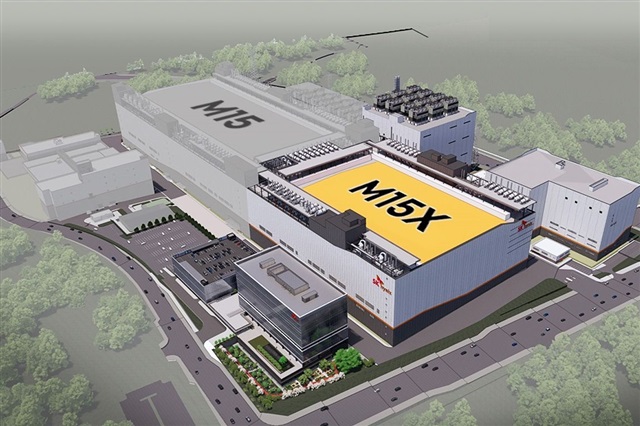
The semiconductor industry serving artificial intelligence, already strained by unprecedented demand, faces a new source of instability. SK Hynix's plant in Cheongju, South Korea, has experienced accidents that are casting a spotlight on operational safety at facilities producing High Bandwidth Memory (HBM). While the company has not released specific details about the nature or severity of the events, the mere fact that they occurred as the Korean giant seeks to accelerate production capacity expansion introduces a note of caution across the entire ecosystem.
What we know about the Cheongju incidents
Public information remains sparse. SK Hynix has confirmed that accidents took place at the Cheongju site but has not provided numbers on production downtime, physical damage, or recovery timelines. Yet the context is enough to raise questions. Cheongju is a strategic hub for HBM manufacturing — the three-dimensionally stacked memory that equips the most powerful GPUs for training and inference of Large Language Models (LLMs). Any interruption, even temporary, during an aggressive growth phase risks slowing an already complex scale-up path.
Why HBM is a fragile yet indispensable link
HBM is not a commodity component. Its architecture of stacked dies interconnected via silicon interposers delivers bandwidths in the hundreds of gigabytes per second per stack — a performance leap over GDDR memory that is essential for handling modern AI workloads. Without HBM, GPUs like the NVIDIA H100 or AMD Instinct MI300X could not sustain the intense data flow required by tensor computation. Organizations building on-premise clusters for LLMs — whether for data sovereignty, low latency, or operational control — depend directly on the availability of these cards. Any turbulence in the HBM supply chain thus translates into concrete risk for deployment projects.
The ripple effect on Total Cost of Ownership
The concentration of HBM production in just a few fabs, with SK Hynix and Samsung dominating the market, leaves the sector vulnerable to localized shocks. Even minor safety incidents can trigger regulatory reviews or operational slowdowns that, in a demand-exceeding-supply regime, fuel price increases. For those planning on-premise infrastructure, assessing TCO now requires factoring in not only accelerator purchase costs but also the premium linked to supply chain volatility. Delays in GPU node deliveries can push back entire LLM fine-tuning or self-hosted serving projects, directly impacting enterprise innovation timelines.
A wake-up call for investors in owned hardware
Beyond the specific episode, what happened in Cheongju signals a structural fragility: the race to scale AI memory is not just a technological challenge but also one of industrial safety. For teams evaluating direct hardware procurement and avoiding the cloud, supply chain diversification and the ability to rely on alternative suppliers — or to adopt architectures less dependent on a single memory type — become strategic levers. Even though there is currently no substitute for HBM in peak-performance scenarios, the incident is a reminder of how important it is to monitor upstream risk factors that no hypervisor can mitigate.




💬 Comments (0)
🔒 Log in or register to comment on articles.
No comments yet. Be the first to comment!