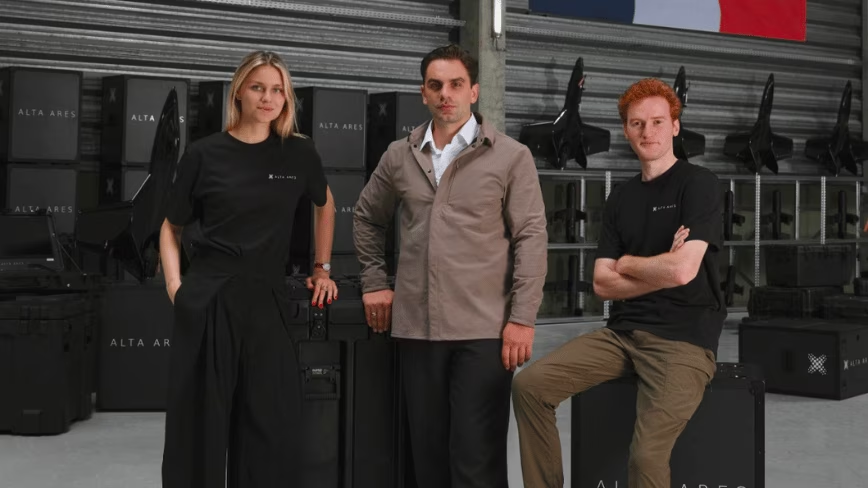
Alta Ares: €50 Million to Make Drone Interception Cheaper Than the Drone Itself
The French startup Alta Ares, founded in Paris in 2024, has announced the closure of a significant €50 million funding round. This investment aims to solve one of the most complex and costly equations in modern defense: the economic disparity between the cost of an attack drone and that of the traditional means used to intercept it.
Currently, an attack drone like the Shahed can cost tens of thousands of euros. However, conventional missiles used to shoot it down can exceed one million euros per shot. This disparity creates a significant strategic and economic challenge for nations that must defend against low-cost, high-volume drone attacks, making large-scale defense unsustainable. Alta Ares's stated goal is to reverse this proportion by developing solutions that make interception more cost-effective than the target itself.
The Technological Context and Economic Implications
The problem of asymmetric costs in anti-drone defense has become increasingly pressing in recent years, with the proliferation of inexpensive and readily available unmanned aerial systems (UAS). An adversary's ability to saturate defenses with low-cost drones, knowing that each interception incurs a vastly higher expense, represents a significant threat not only on the battlefield but also to critical infrastructure and national security.
Traditional solutions, based on surface-to-air or air-to-air missiles, were designed to counter more sophisticated and expensive threats, such as warplanes or ballistic missiles. Their high cost reflects the technological complexity and precision required for such engagements. However, applying these same logics to less costly and more numerous threats results in an unsustainable Total Cost of Ownership (TCO) for defense systems. Innovation in this sector is crucial to maintaining a defensive advantage without draining security budgets.
Sovereignty, Control, and New Deployment Paradigms
The pursuit of more economical anti-drone solutions is not just a budgetary matter; it also touches on issues of sovereignty and control. Reliance on expensive defense systems, potentially supplied by external actors, can limit a nation's operational autonomy. Developing internal capabilities, such as those proposed by Alta Ares, allows for greater control over technology, the supply chain, and deployment strategies.
For organizations and nations evaluating the deployment of advanced defense systems, TCO consideration is paramount. Solutions that drastically reduce the cost per interception can transform the economic equation of defense, making it possible to protect wider areas or manage more persistent threats. Although the source does not specify hardware or deployment details, it is plausible that such systems would require robust infrastructure, potentially self-hosted or air-gapped, to ensure maximum security and data sovereignty, central aspects of AI-RADAR's philosophy.
Future Prospects and Technological Challenges
The €50 million funding positions Alta Ares as a promising player in the defense technology landscape. The challenge now will be to translate this investment into concrete and scalable solutions that can effectively reverse the cost/benefit ratio in drone interception. This could include the development of new forms of interceptors, AI-powered systems for identification and tracking, or innovative approaches to electronic warfare.
The success of initiatives like Alta Ares will have a significant impact on global defense strategy, pushing towards a more sustainable and efficient approach to protection against unmanned aerial threats. The ability to respond to these threats in an economically advantageous way is essential for future security, and innovation in this field is set to remain a top priority for technological and military decision-makers.







💬 Comments (0)
🔒 Log in or register to comment on articles.
No comments yet. Be the first to comment!