Chip Diplomacy in a Tense Geopolitical Landscape
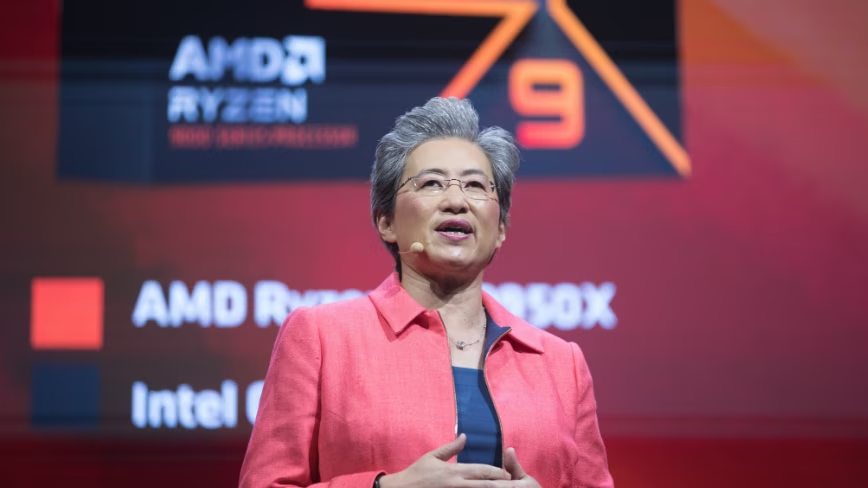
AMD's CEO, Lisa Su, met with Chinese Vice Premier He Lifeng on Monday at the Great Hall of the People in Beijing. This summit holds particular significance at a time when US chip manufacturing companies find themselves having to balance increasing pressure from Washington, which is tightening controls on technology exports, with the need to maintain and protect their market share in China. The Chinese market, in fact, represents the second largest globally for semiconductors, making it a crucial arena for industry giants.
The stakes are high. On one hand, US policies aim to limit China's access to advanced technologies, particularly those related to artificial intelligence and Large Language Models (LLMs), for national security reasons. On the other hand, companies like AMD heavily rely on revenue generated in this vast market. The ability to navigate these turbulent waters is fundamental for their long-term sustainability and growth.
Implications for Hardware and On-Premise Deployments
Geopolitical tensions and export restrictions have a direct impact on the availability and cost of critical AI hardware, such as high-performance GPUs. For companies evaluating the deployment of LLMs and other AI workloads in self-hosted or on-premise environments, this situation introduces additional complexities. Infrastructure planning must consider not only technical specifications like VRAM, throughput, and Inference capabilities, but also supply chain risks and potential future restrictions.
Data sovereignty and regulatory compliance are often the primary drivers behind choosing an on-premise or air-gapped infrastructure. However, if access to certain types of silicon or specific Frameworks becomes limited, companies might face difficult trade-offs. This can affect the overall Total Cost of Ownership (TCO), pushing towards alternative solutions or the exploration of suppliers less exposed to such geopolitical dynamics. AI-RADAR, for instance, offers analytical frameworks on /llm-onpremise to evaluate these complex trade-offs, providing tools for informed decisions.
Future Outlook and Corporate Strategies
The meeting between Lisa Su and He Lifeng is a clear signal that "chip diplomacy" is an essential component of corporate strategy in the technology sector. Companies can no longer afford to ignore the geopolitical context, which directly influences their production pipelines, market strategies, and innovation capabilities. Finding a balance between compliance with national regulations and maintaining global competitiveness becomes a constant challenge.
In this scenario, decisions regarding AI infrastructure, both for training and Inference, require a long-term strategic vision. Diversification of suppliers, investment in local research and development, or the adoption of more flexible hardware architectures less dependent on a single ecosystem, could emerge as key strategies. The ability to adapt quickly to an evolving regulatory and commercial landscape will be crucial for success in the semiconductor industry and, by extension, for the entire artificial intelligence ecosystem.







💬 Comments (0)
🔒 Log in or register to comment on articles.
No comments yet. Be the first to comment!