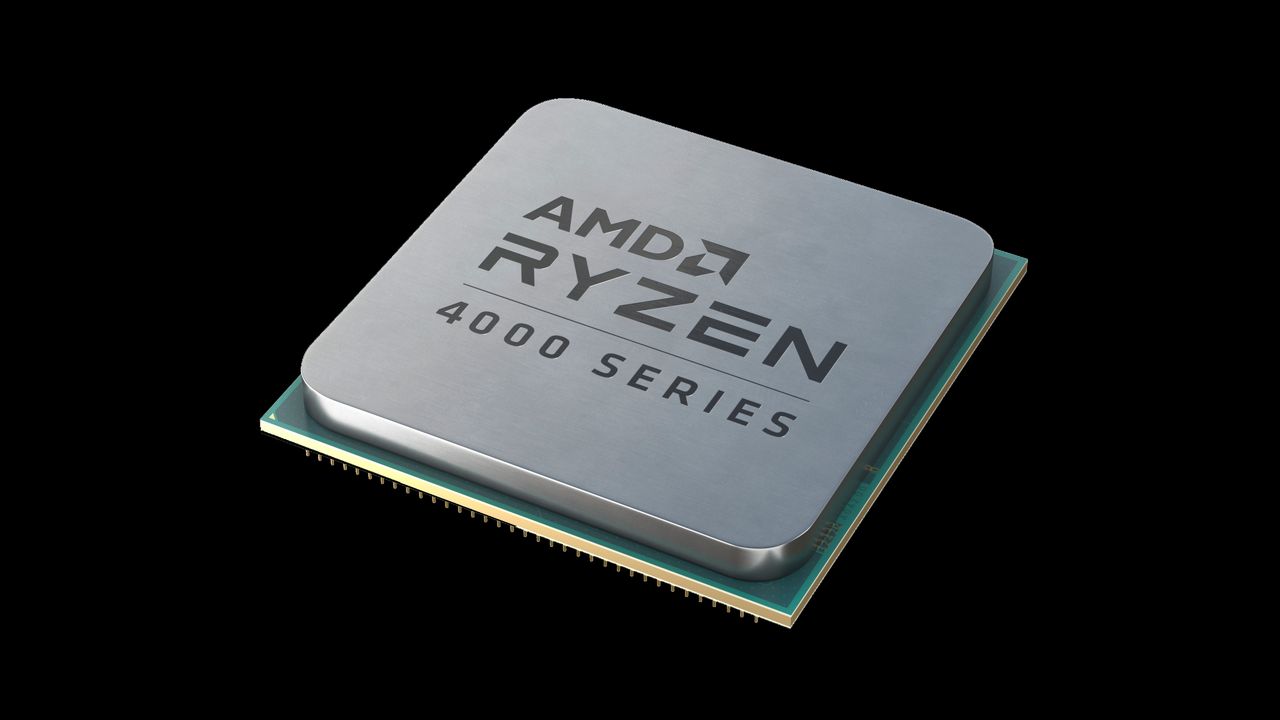
Four-year-old silicon resurfacing in a brand-new system: AMD has revived the Ryzen 7 4700LE, an eight-core Zen 2 chip that seemed consigned to OEM history, slotting it into an $800 prebuilt PC alongside a GeForce RTX 3050. The configuration says a lot about the breathing room of builders in the budget segment, but it also opens a concrete—if narrow—window for those eyeing local LLM inference.
The Ryzen 7 4700LE is a processor without modern pretensions: no integrated graphics, modest clock speeds, and an AM4 platform now surpassed in many respects. Next to it, the RTX 3050 with 8 GB of GDDR6 VRAM is the only real engine for vector computation. That single detail defines the on-premise inference equation.
Anyone trying to run an LLM on a machine like this must negotiate with video memory. Eight gigabytes force heavy quantization, typically to 4-bit, to fit models in the 7-billion-parameter range. The result is a system that can produce tokens, but with a truncated context window and latency that rules out any fluid interactive use. CPU-only inference would be even more punishing, with response times impractical for serious work.
Yet, this configuration has a plausible audience. Hobbyists, fledgling researchers, or small outfits wanting to test retrieval-augmented generation pipelines in air-gapped environments might see it as a low-cost starting point. Data sovereignty, in these cases, trades off against modest performance without tying the user to a third-party cloud. The $800 price tag encapsulates a whole philosophy: bring inference inside the home or office, and live with the compromises.
AMD’s move to keep supplying Zen 2 silicon signals a broader phenomenon. The hardware market’s inertia keeps years-old architectures alive, stretching their availability far beyond expectations. For budget on-premise deployment, that’s a double-edged sword: it lowers the entry barrier for newcomers, but it also cements a performance tier that is already insufficient for many workloads. The RTX 3050, born for light gaming, becomes here the declared bottleneck of any AI ambition.
The system is no benchmark for those chasing performance, but a reminder of how wide the gap is between entry-level hardware and machines capable of serious inference. That distance isn’t just a matter of architectural generations, but of VRAM capacity and the lack of features like native FP8 support or unified memory architectures. Anyone evaluating on-premise deployment will have to reckon with this reality: a low upfront cost almost always translates into bottlenecks that limit the application horizon.



💬 Comments (0)
🔒 Log in or register to comment on articles.
No comments yet. Be the first to comment!