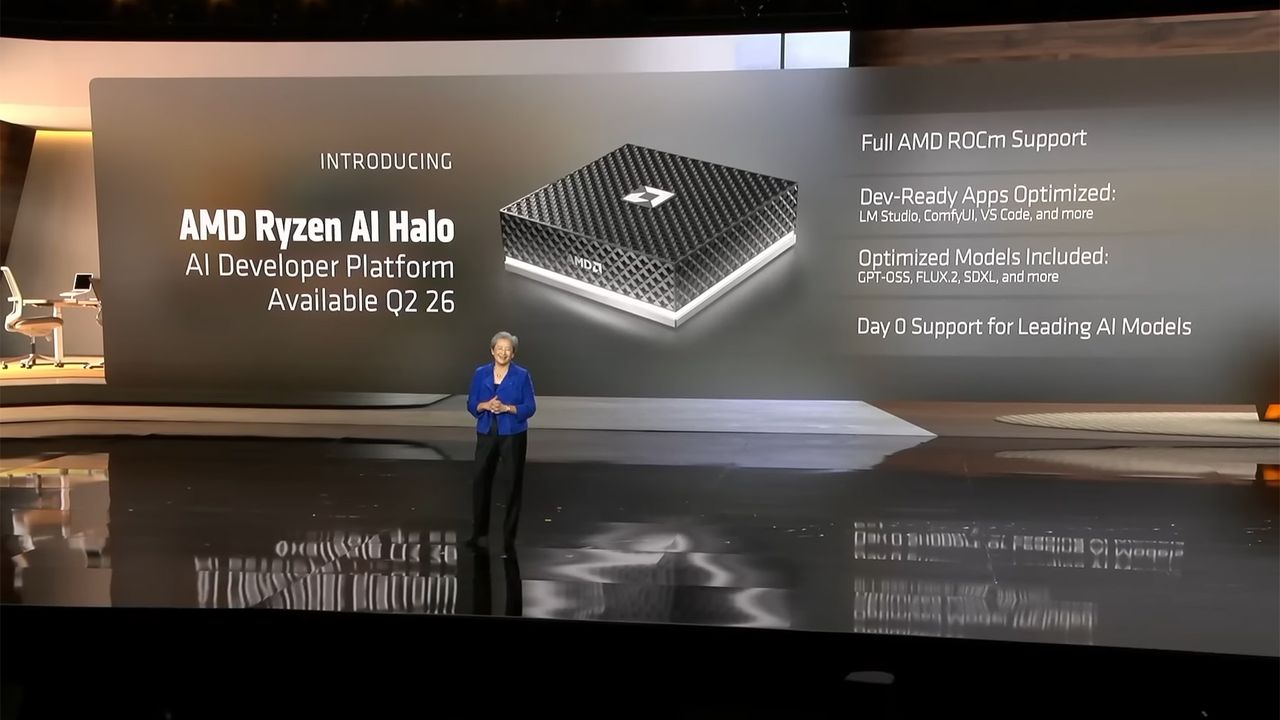
AMD Ryzen AI Halo: A New Proposition for On-Premise AI
AMD has recently announced the launch of the Ryzen AI Halo, a desktop system designed to address the growing demands of artificial intelligence workloads directly on-premises. This move positions AMD in direct competition with existing solutions on the market, particularly Nvidia's DGX Spark, offering a proposition that aims to combine significant performance with a more accessible cost. The Ryzen AI Halo emerges as a strategic option for companies looking to maintain control over their data and AI operations, reducing reliance on external cloud infrastructures.
AMD's new desktop system stands out with a launch price of $3,999, a value that makes it approximately $700 cheaper than its Nvidia counterpart. This cost difference can be a decisive factor for organizations evaluating investment in dedicated AI hardware. The availability of a system with native Windows 11 support also facilitates its integration into existing enterprise IT environments, lowering the entry barrier for the development and deployment of AI applications.
Technical Details and Unified Memory Advantages
At the core of the Ryzen AI Halo is a robust hardware configuration, featuring 128GB of unified memory. This memory approach is particularly advantageous for Large Language Models (LLM) workloads, where memory capacity and access speed are crucial. Unified memory allows the CPU and GPU to access the same high-bandwidth memory pool, eliminating the need to transfer data between separate memories (such as system RAM and dedicated VRAM). This can result in lower latency and higher throughput during the inference and fine-tuning of complex models.
For professionals working with LLMs, having 128GB of unified memory means being able to load considerably sized models, including those with billions of parameters, and manage larger context windows. This is a fundamental aspect for applications requiring the processing of large volumes of text or data in real-time. The ability to run these models locally, without resorting to cloud services, reinforces the concept of data sovereignty and offers granular control over the execution environment.
Implications for On-Premise Deployments
The introduction of solutions like AMD's Ryzen AI Halo is particularly relevant for CTOs, DevOps leads, and infrastructure architects evaluating on-premise or hybrid deployment strategies for their AI workloads. The ability to acquire powerful hardware at a competitive cost allows companies to develop and test LLMs internally, keeping sensitive data within the corporate perimeter. This is crucial for regulated sectors or for organizations with stringent compliance and privacy requirements, such as those imposed by GDPR.
An AI desktop system can serve as an ideal platform for rapid prototyping, fine-tuning models on proprietary datasets, and running inference for edge applications or in air-gapped environments. While dedicated server solutions offer superior scalability and density, a high-end desktop like the Ryzen AI Halo can represent a more accessible entry point to start capitalizing on the benefits of local AI, with a potentially lower Total Cost of Ownership (TCO) compared to long-term cloud options, considering recurring data transfer and computation costs.
Future Outlook and Competitive Scenarios
AMD's move with the Ryzen AI Halo intensifies competition in the AI hardware market, traditionally dominated by a few players. This competition is a positive factor for businesses, as it stimulates innovation and offers a wider range of hardware choices, each with its own trade-offs in terms of cost, performance, and scalability. For companies aiming to build their own AI infrastructure, having more options means being able to select the solution that best aligns with their budget constraints, performance requirements, and deployment strategies.
AI-RADAR, in its commitment to providing in-depth analysis of on-premise solutions, highlights how the availability of hardware like the Ryzen AI Halo can facilitate the adoption of self-hosted strategies for LLMs. For those evaluating the trade-offs between on-premise and cloud deployment, analytical frameworks are available at /llm-onpremise that can help define the most suitable solution. The goal is always to maximize control, security, and operational efficiency, while ensuring the flexibility needed to evolve with the demands of artificial intelligence.



💬 Comments (0)
🔒 Log in or register to comment on articles.
No comments yet. Be the first to comment!