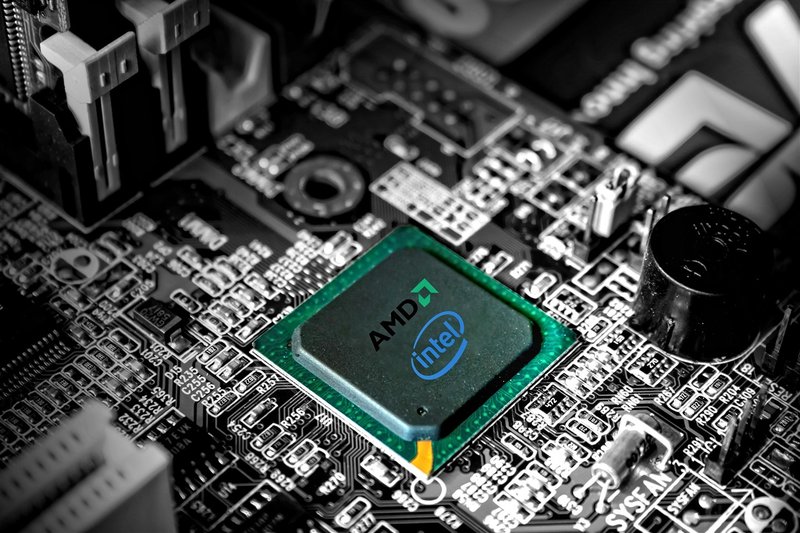
It's not just GPUs anymore: the hardware acceleration race for artificial intelligence is increasingly staking a claim on x86 CPUs. AMD just submitted patches to bring AVX10_V2_AUX ISA support into GCC, hot on the heels of Intel's earlier work on AI Compute Extensions (ACE). The synchronization stems from the x86 Ecosystem Advisory Group, a table where silicon designers collaborate to avoid fragmenting the instruction set. The message is unambiguous: CPU compute wants a seat at the AI inference table, far from the grip of graphics chips.
The AVX10 extension, in its version 2 with the AUX suffix, promises to add vector operations optimized for matrix multiplications and other patterns typical of language models. This isn't entirely new – Intel's AVX-VNNI and AMX already brought neural network acceleration to Xeon – but AMD's move into GCC signals that the next generation of x86 processors from both manufacturers will bundle these instructions, making them uniformly available across servers, desktops, and possibly notebooks.
For organizations running large language models on-premise, the question is no longer whether to use a GPU, but whether one is truly necessary. Models with 7–13 billion parameters, quantized to 4 or 8 bits, can run on CPUs with acceptable performance for many enterprise use cases: document analysis, internal assistants, low-latency conversational agents. The arrival of AVX10_V2_AUX won't rival an H100 in tokens per second, but it can erode the economic justification for dedicated accelerator infrastructure in many settings.
It's not about brute force, it's about control. A CPU-only server simplifies management: no CUDA drivers to update, no memory contention between workloads, lower energy consumption, compatibility with any Linux distribution. Above all, data stays where it was born, without invoking cloud APIs. In regulated sectors – healthcare, banking, public administration – this is often the prerequisite for any AI project.
The joint move by AMD and Intel signals that ISA convergence isn't just a compiler leasing detail; it's an ecosystem enabler. If AI instructions become a de facto x86 standard, developers and frameworks (from PyTorch to ONNX Runtime) can compile optimized kernels once and ship them across millions of machines. The TCO of widespread AI adoption drops sharply because you can leverage hardware already in place or replaced through normal server refresh cycles. It's not just a win for CPUs: it deals a blow to the notion that serious inference always requires a dedicated accelerator, reshaping the balance for those who choose self-hosted infrastructure as a sovereignty safeguard.






💬 Comments (0)
🔒 Log in or register to comment on articles.
No comments yet. Be the first to comment!