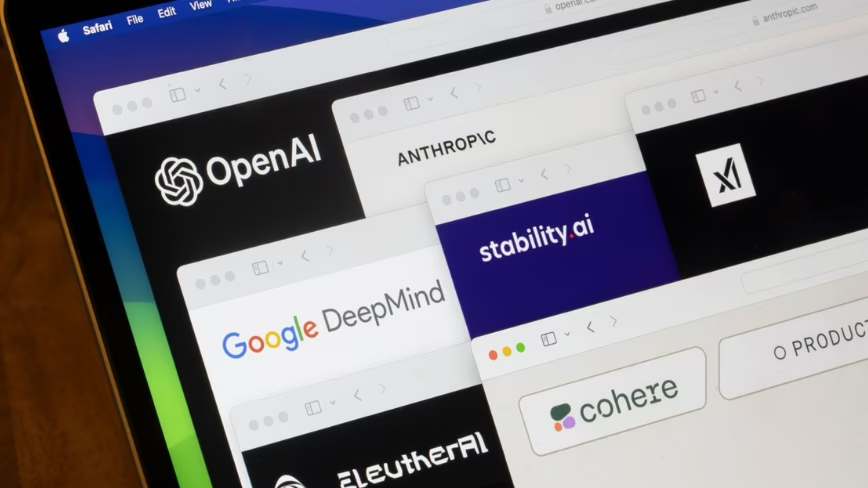
A Proposal for Global AI Governance at the G7
During a closed-door meeting held at the G7 summit, Dario Amodei, CEO of Anthropic, and Demis Hassabis of Google DeepMind formally requested the establishment of an artificial intelligence coalition. The initiative, proposed to be led by the United States, aims to set a framework of international rules and standards for the development and use of AI. The discussion, revealed by anonymous sources familiar with the matter, underscores the growing urgency to address the global implications of AI at a political and regulatory level.
The proposal highlights how key industry players recognize the need for coordinated governance to guide the trajectory of this emerging technology. The absence of global consensus on how to manage AI could lead to regulatory fragmentation, slowing innovation or, conversely, exposing unmanaged risks. The appeal to the G7, a forum of industrialized nations, suggests an attempt to catalyze joint action among the most influential economies.
The Context of AI Regulation and Its Impacts
The call for an international coalition is part of a broader debate on artificial intelligence regulation, which sees governments and international organizations committed to defining ethical and secure approaches. The goal is to balance technological innovation with the protection of individual rights and social stability. The creation of common standards could simplify the AI adoption process for businesses, providing clear guidelines for the development and deployment of Large Language Models (LLM) and other AI applications.
However, defining such standards is not without complexity. Different nations and economic blocs have varying views on key issues such as data privacy, algorithm transparency, and accountability. A US-led coalition, as proposed, would need to navigate these differences to build broad and lasting consensus, preventing regulations from becoming an insurmountable obstacle for companies operating globally.
Implications for On-Premise Deployment and Data Sovereignty
For organizations evaluating the deployment of AI solutions, particularly those opting for self-hosted or on-premise architectures, the evolution of international regulations is of paramount importance. Clear global standards could directly influence compliance requirements, data sovereignty management, and infrastructure decisions. For example, rules on data localization or model certification might dictate technical specifications for hardware and software used in air-gapped or hybrid environments.
The ability to maintain control over one's data and AI models is a priority for many companies, especially in regulated sectors. Well-defined international governance could provide a framework to ensure that on-premise deployments comply with global regulations, reducing legal and operational risks. Conversely, regulatory fragmentation could increase complexity and TCO for companies seeking to operate across multiple jurisdictions, making the choice between cloud and self-hosted solutions more difficult.
Future Prospects and the Trade-offs of Standardization
The proposal by Anthropic and Google DeepMind at the G7 marks a significant step towards a more coordinated approach to AI governance. However, the path to adopting unified international standards is long and fraught with challenges. Negotiation among national interests, geopolitical dynamics, and the rapid evolution of the technology itself will require sustained commitment and considerable flexibility from all involved stakeholders.
Businesses and technology decision-makers will need to closely monitor these developments. The choice between on-premise, cloud, or hybrid deployment, the selection of hardware for inference and training, and compliance management will be increasingly influenced by the global regulatory landscape. Understanding the trade-offs between flexibility, cost, security, and compliance will be crucial for effectively navigating this evolving scenario. For those evaluating on-premise deployment, AI-RADAR offers analytical frameworks on /llm-onpremise to assess these trade-offs.






💬 Comments (0)
🔒 Log in or register to comment on articles.
No comments yet. Be the first to comment!