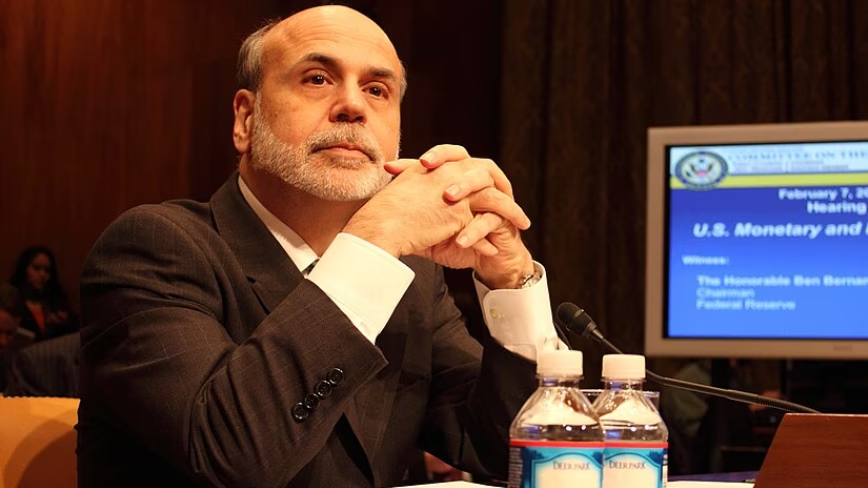
Anthropic didn’t pick just any advisor for its Long-Term Benefit Trust. Ben Bernanke led the Federal Reserve during the 2008 financial meltdown, steering interest rates and liquidity as the global banking system teetered. The appointment, announced Thursday, casts the long shadow of systemic risk management experience over the AI company’s governance – the kind of risk nobody sees coming until it explodes.
The trust is an entity designed to watch over Anthropic’s long-term direction, separate from immediate commercial interests. It’s a mechanism reminiscent of foundations at some European tech firms, but with a specific goal: preventing the profit race from sidelining model safety. Bernanke, a 2022 Nobel laureate in economics, brings not just academic credibility but the instinct of someone who knows that macroeconomic risks – and advanced AI risks – share a trait: they are non-linear, interconnected, and hard to predict from historical data alone.
Why this appointment matters for those evaluating on-prem LLMs
For a company considering hosting a language model on its own servers, the choice of vendor goes beyond benchmarks and cost. Governance strength matters, especially when sensitive data stays on-premise due to regulatory or sovereignty constraints. If the model is updated, if safety policies shift, if the vendor gets acquired or changes course, organizations that invested in local deployment want guarantees that core principles won’t be upended. Bernanke’s presence on the trust signals that Anthropic aims to build a ring of independent oversight, insulated from shareholder pressure. Even though today it operates mostly via cloud, that signal could tip the scales for those architecting local stacks and seeking a partner aligned for the long haul.
There’s a parallel with finance: after 2008, central banks strengthened macroprudential oversight. Anthropic seems to be applying the same template to AI – a “stability board” that looks beyond quarterly earnings. That may not be enough, but it’s the kind of move that raises the bar for the entire sector. And it poses an implicit question to other vendors: who else has a comparable oversight structure?
The appointment comes as European companies, driven by GDPR and the AI Act’s guidelines, start mapping third-party risks in their AI supply contracts. In this environment, a trust featuring a Nobel winner who handled the worst financial crisis of the century becomes a significant communication and contractual asset. It doesn’t provide absolute guarantees, but it shifts the boundary of trust – and for those deploying on-premise, trust in the vendor is the prerequisite for everything else.
The game is long. Anthropic isn’t the first to create an independent ethics board, but recruiting Bernanke raises the profile of the public conversation on AI governance. As models grow more powerful and integrate into critical infrastructure, the question will no longer be just “how well does the model perform,” but “who controls who builds it.” Technicians designing on-premise architectures today would do well to add this item to their checklist, right alongside VRAM, latency, and throughput.





💬 Comments (0)
🔒 Log in or register to comment on articles.
No comments yet. Be the first to comment!