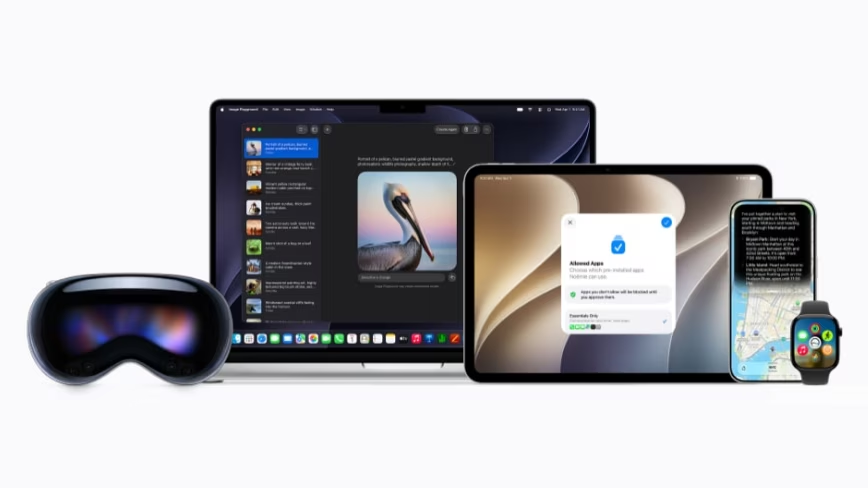
Apple Redefines Siri with Gemini Integration and a New Privacy Approach
Apple unveiled Siri AI during its annual developer conference, WWDC 2026, marking the most significant overhaul of its voice assistant in fifteen years. The announcement, made at Apple Park, introduces a completely rebuilt version of Siri, based on a custom Gemini model developed in collaboration with Google. This update not only enhances conversational capabilities but also introduces a three-tier privacy architecture and the ability to use Siri as a standalone application.
Apple's move reflects the growing importance of Large Language Models (LLM) in the technological landscape and the need to integrate advanced AI capabilities into consumer products. The collaboration with Google for the adoption of a custom Gemini model underscores the complexity and resources required for developing cutting-edge LLMs, prompting even tech giants to form strategic alliances.
Technical Details and the Privacy Architecture
The core of the new Siri AI lies in its foundation: a Google Gemini model, appropriately customized for Apple's needs and ecosystem. This customization is crucial, as it allows Apple to maintain a degree of control over the model's training and features, while still benefiting from the power and efficiency of an established LLM. The integration of a third-party model, even if customized, raises questions and opportunities for companies evaluating AI deployment strategies.
A distinctive aspect of Siri AI is the introduction of a three-tier privacy architecture. Although specific details have not been fully disclosed, a multi-tier approach to privacy suggests granular management of user data, potentially distinguishing between on-device processing, processing on Apple servers, and, for more complex tasks, anonymized submission to external services. This design aims to offer users greater transparency and control over their data, an increasingly relevant theme in the context of generative AI.
Implications for Deployment and Data Sovereignty
Apple's adoption of a custom Gemini model highlights a common trade-off in the LLM sector: balancing the rapid innovation offered by third-party models with the need for control, customization, and data sovereignty. For CTOs, DevOps leads, and infrastructure architects, the decision to use pre-trained models or develop in-house solutions is complex. Apple's approach, combining an external model with internal customization and a robust privacy architecture, could serve as a benchmark for other companies.
The "three-tier privacy stack" is particularly interesting for those operating in environments with stringent compliance requirements or in air-gapped contexts. Such a system could allow sensitive data to remain on-device or on self-hosted infrastructures, delegating only less critical processing to external services, or even performing everything locally with appropriately quantized models. For those evaluating on-premise deployments, analytical frameworks are available at /llm-onpremise to assess trade-offs between control, performance, and TCO, also considering the impact of layered privacy architectures.
Future Prospects and Market Context
The Siri AI update represents a significant step for Apple in its journey to integrate advanced artificial intelligence. The choice to collaborate with Google for the Gemini model, while maintaining a strong focus on privacy and customization, reflects a pragmatic strategy in a rapidly evolving AI market. This move not only positions Apple more competitively in the voice assistant landscape but also sets new standards for privacy management in the LLM era.
The evolution of Siri AI and its multi-tier privacy architecture will impact how companies conceive and implement their AI solutions. The ability to offer advanced functionalities while maintaining a high level of data control is a challenge many organizations face. Apple's approach offers an example of how to navigate this complex balance, providing a reference point for future deployment and development decisions in the sector.





💬 Comments (0)
🔒 Log in or register to comment on articles.
No comments yet. Be the first to comment!