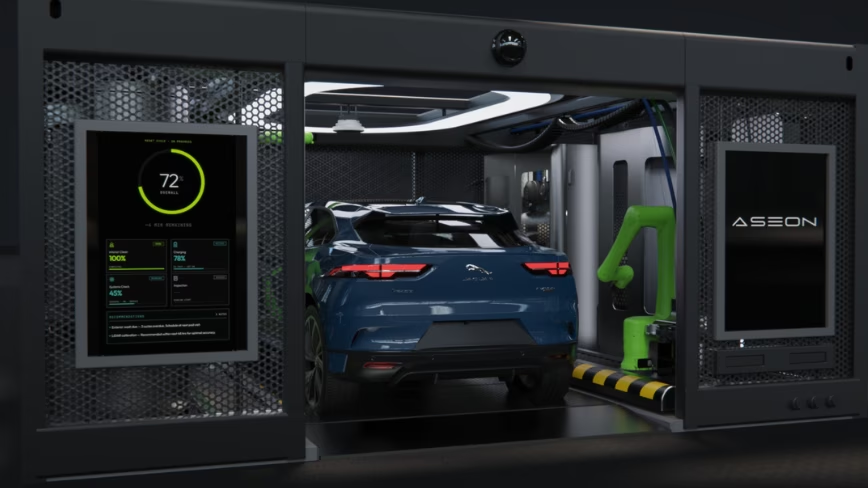
Aseon Labs, based in Redwood City, has just closed a $10 million seed round to build automated pods that promise to make robotaxi fleet management more efficient and hands-off. Crane Venture Partners led the investment, with participation from Y Combinator, Expa (Garrett Camp’s venture firm, Uber co-founder), Robin Hood Ventures, Founders Capital, and angels like Mercury founder Immad Akhund.
The modules – about the size of a parking space – are designed to charge and clean vehicles without human intervention, addressing a piece of the autonomous driving ecosystem that has remained largely overlooked. The news, reported exclusively by TechCrunch, comes as robotaxi fleets begin to move beyond pilot phases and require dependable, widely distributed support infrastructure.
Physical upkeep meets distributed compute: the last-mile logistics gap
Autonomous driving research has long focused on sensors, algorithms, and onboard compute power. Less attention has gone to the mundane operations: who recharges the batteries, who sanitises interiors between rides, how to handle idle time efficiently. Aseon Labs’ pods aim to provide an industrial answer, turning ordinary parking spots into automated micro-hubs.
From an architectural standpoint, bringing charging and cleaning physically close to the vehicles mirrors the edge computing logic that is increasingly central to artificial intelligence. A robotaxi pulling into a pod does more than replenish its battery – as the platform evolves, it could offload telemetry data, update perception models, or run local fine-tuning for new road scenarios, cutting cloud dependency and data transmission costs.
Less cloud, more control: data sovereignty on wheels
Autonomous fleets generate vast amounts of video, lidar and radar data. Handling this data raises privacy concerns and questions about compliance with regulations such as GDPR, especially when vehicles operate in European public spaces. Shifting part of the processing and diagnostics to nearby facilities – even if initially mechanical, like Aseon’s pods – reduces data exposure and increases operator control.
This trend parallels what is happening with on-premise data centres for Large Language Models: organisations are paying closer attention to TCO and latency, avoiding the need to send every request to external servers. In the robotaxi world, the “data centre” becomes a smart parking bay where compute and maintenance coexist, with potential benefits for cybersecurity and service uptime.
Investors bet on the invisible infrastructure
The presence of Crane Venture Partners, historically focused on developer tools and software infrastructure, and Expa, rooted in mobility, suggests the market is recognising the value of enabling layers – often less visible but crucial for scaling real-world operations. Building autonomous vehicles is only part of the equation; making their lifecycle sustainable and governable is the other half.
From a deployment perspective, robotaxi operators will soon need to decide whether to rely on third-party solutions for physical maintenance and data handling, or build their own network of micro-hubs. Aseon Labs’ pods represent a piece of what could become a distributed infrastructure for AI on wheels, where every charging stall is also a potential local compute node.
For those evaluating on-premise deployment scenarios in AI, similar trade-offs between control and operational costs are at play. The Aseon story shows that the conversation is expanding from server rooms to the physical world of mobility.








💬 Comments (0)
🔒 Log in or register to comment on articles.
No comments yet. Be the first to comment!