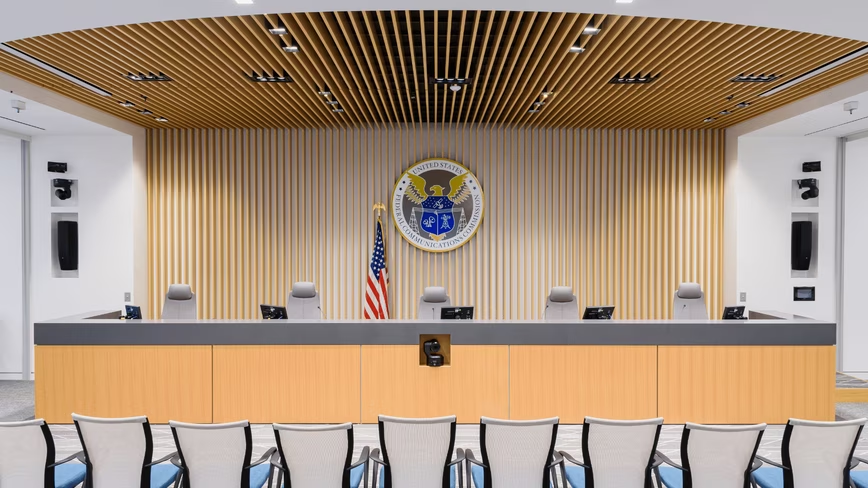
A US spectrum auction has exceeded expectations, but the political weight lies in where the money will go. The Federal Communications Commission raised about $3.5 billion, and almost all of it is earmarked to fund the removal of Chinese-made equipment, primarily from Huawei and ZTE, from American telecommunications networks. This is not new: the federal “rip and replace” program has been around for years, but this capital injection marks a decisive acceleration, with implications that go well beyond the telecom sector.
What the “rip and replace” program entails
Administered by the FCC, the program offers reimbursements to smaller providers – often rural or low-density – to replace every piece of network gear made in China with alternatives from suppliers deemed trustworthy. The process is slow, costly, and technically complex: it’s not just about swapping an antenna, but reworking entire architectures, from the core network to access equipment. Funding it through a mid-band spectrum auction is a choice with consequences: resources that could have driven innovation are instead channeled into a forced supply-chain cleanup.
Sovereignty beyond telecom: the Huawei precedent
The campaign against Huawei is not new. For years, Washington has labeled the company’s products as potential vehicles for espionage, though never backed by unequivocal public evidence. Yet the technical question is secondary to the geopolitical signal: every network node is an access point to sensitive data, and dependence on a single foreign supplier is seen as a systemic vulnerability. The $3.5 billion auction turns this distrust into a concrete expense, a cost the federal government shoulders to reassert control over critical infrastructure.
Trade-offs for smaller carriers
For smaller operators, the “rip and replace” program is a financial lifeline, but it brings significant operational complexity. Swapping out live equipment requires downtime, coverage redesign, and sometimes the need to run old and new systems in parallel for months. Moreover, alternative gear is not unlimited: Ericsson and Nokia risk becoming bottlenecks, with delivery times stretching. The spectrum auction cushions the economic blow, but does not eliminate the risk of lock-in with new, in this case Western, vendors.
Lessons for on-premise infrastructure choices
Though the context is telecom, the underlying logic speaks to anyone managing sensitive workloads, including the LLM universe. Data sovereignty is not an abstract notion: it means being accountable at all times for the security of the physical devices running your models. The “rip and replace” approach shows how procurement decisions become acts of geopolitics, and how the cost of trust cascades across the supply chain. For those evaluating on-premise deployment, similar trade-offs exist: between TCO and control, between dependence on a proprietary ecosystem and the freedom to audit. AI-RADAR provides analytical frameworks for navigating these choices, particularly around inference and fine-tuning of self-hosted LLMs.
The $3.5 billion auction is more than a round number. It is a litmus test for an era in which technology is a weapon, and hardware is territory. Removing Huawei is not the end, but the beginning of a supply-chain reconfiguration that will touch more and more sectors – AI included.







💬 Comments (0)
🔒 Log in or register to comment on articles.
No comments yet. Be the first to comment!