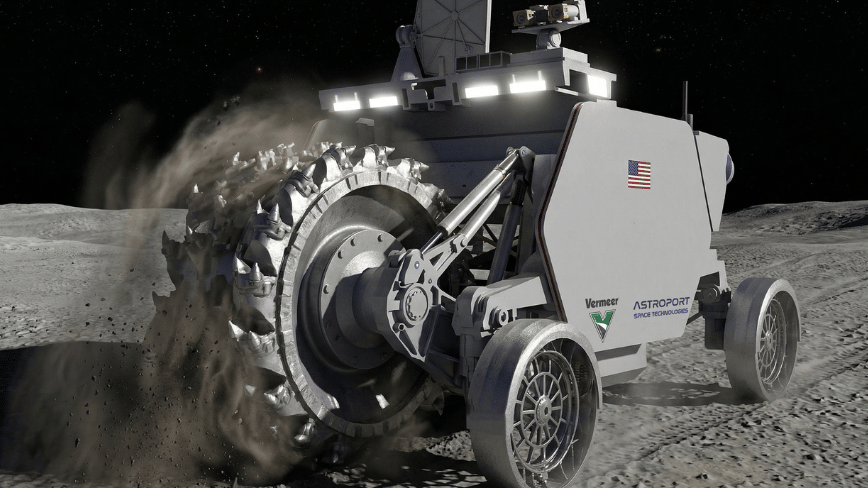
Astroport and Vermeer's Vision for the Moon
Astroport Space Technologies and Vermeer Corporation have forged a strategic partnership with the ambitious goal of bringing heavy construction to the Moon. The collaboration focuses on adapting industrial surface mining equipment for autonomous construction operations in the lunar environment. This initiative, announced during the 20th International Conference on Engineering, Science, is presented by the two companies as a fundamental step in providing the so-called "Lunar Iron" – the heavy equipment indispensable for establishing a stable and lasting human presence on our natural satellite.
The project addresses a growing need for robust and self-sufficient infrastructure to support future space missions. The idea of using industrial machinery already proven on Earth, but readapted for the Moon's extreme conditions, represents a pragmatic approach to accelerate the development of extraterrestrial construction capabilities. The challenge is not only engineering but also computational, given the necessity for autonomous systems capable of operating with minimal human supervision.
Technical Challenges of Lunar Autonomy
Adapting industrial machinery for the lunar environment entails a series of significant technical challenges. Beyond the need to make the hardware resistant to radiation, extreme temperatures, vacuum, and abrasive dust, the project's core lies in developing autonomous construction capabilities. This requires advanced artificial intelligence and machine learning systems for navigation, path planning, material identification and manipulation, and real-time operation management.
To ensure autonomy, these machines will need to integrate sophisticated sensors and on-board data processing capabilities, reducing reliance on constant communication with Earth. This implies the use of robust computational architectures, capable of executing complex AI and LLM algorithms for on-site decision-making. Managing VRAM, throughput, and latency will become crucial for operational efficiency, especially in a context where every Watt of energy is precious and every error can have catastrophic consequences. The resilience of software and hardware in an air-gapped environment will be paramount.
Implications for Space Infrastructure and Data Sovereignty
The availability of "Lunar Iron" and the ability to construct autonomously on the Moon open up unprecedented scenarios for space exploration and colonization. From building habitats and landing pads to in-situ resource utilization (ISRU), lunar infrastructure will require an approach that prioritizes self-sufficiency and local control, concepts that resonate with on-premise deployment philosophies. The ability to operate independently from Earth minimizes risks associated with communication delays and external vulnerabilities.
In such an isolated context, data sovereignty takes on an even more critical dimension. Data generated by autonomous operations, from geological surveys to machinery performance, must be managed, processed, and stored securely and under control. This lunar scenario, by its intrinsically air-gapped and self-hosted nature, offers an extreme example of the resilience, security, and control requirements that many organizations seek in their on-premise AI deployments. For those evaluating on-premise deployments, AI-RADAR offers analytical frameworks on /llm-onpremise to assess similar trade-offs in terms of control and TCO.
Future Prospects and TCO Considerations
The collaboration between Astroport and Vermeer represents a significant step towards realizing a permanent human presence on the Moon. The emphasis on autonomy and the adaptation of existing technologies highlights a strategic approach aimed at optimizing costs and development times. However, the Total Cost of Ownership (TCO) for such initiatives is considerable, encompassing not only research and development but also launch, maintenance, and upgrade costs in such a hostile environment.
The success of projects like this will depend on the ability to develop systems that are not only robust and efficient but also easily maintainable and upgradeable remotely. Lessons learned in developing autonomous infrastructure for the Moon could also find application in extreme terrestrial contexts or scenarios where connectivity is limited, reinforcing the importance of AI and LLM solutions that can operate independently and securely. This long-term vision underscores the interconnection between space innovation and the needs of advanced technological infrastructure.







💬 Comments (0)
🔒 Log in or register to comment on articles.
No comments yet. Be the first to comment!