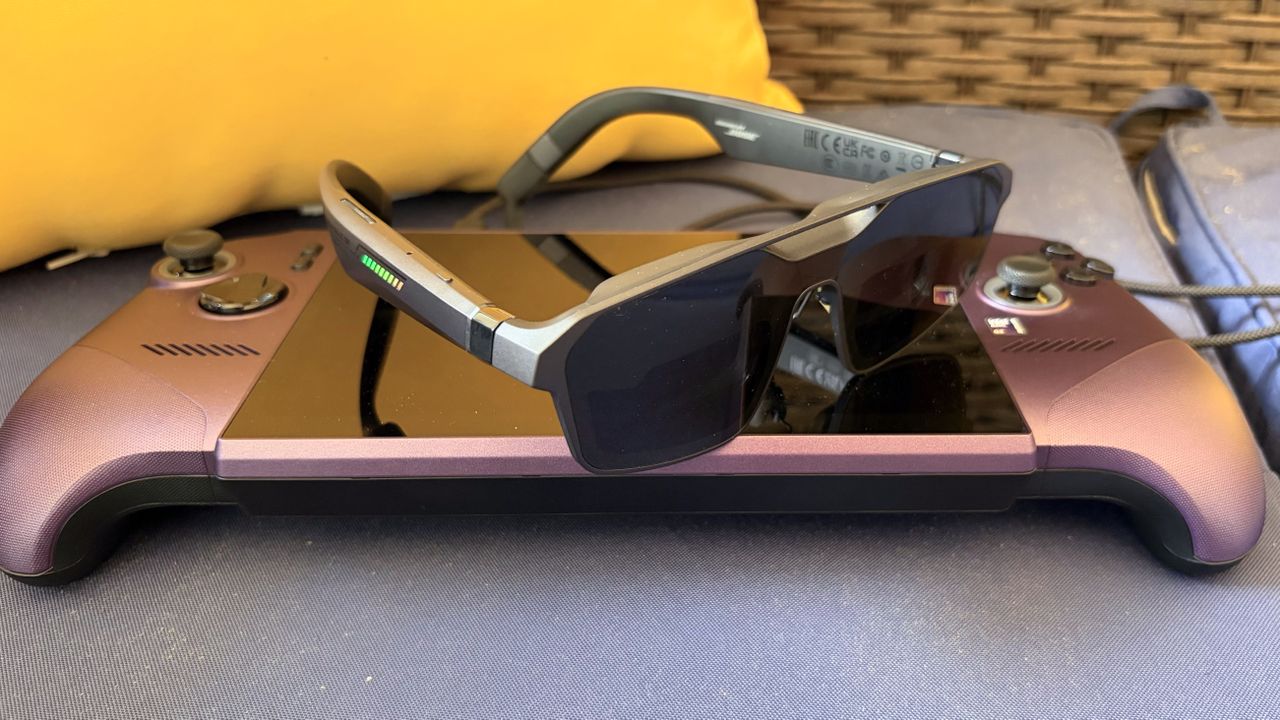
The news, or rather the non-news, starts with a title that sounds like a gaming appetizer: "Asus ROG Xreal R1 Review: Gaming-focused AR glasses deliver 240 Hz performance and RGB style." Too bad the main course never arrives. Opening the content, you find only the biography of an editor who has been tinkering with custom PCs for thirty years. No data, no benchmarks, no mention of hardware. A ghost review that says more by what it doesn't say than by the absent substance.
For AI-RADAR, accustomed to digging through GPU specs, memory, and deployment stacks, such an informational void is more instructive than many presentations. Because if an AR device is labeled as "gaming-focused" with a 240 Hz refresh, it’s immediately clear that the rendering pipeline – and potentially the inference for augmented reality features – must live close to the user. No round-trip to the cloud, otherwise nausea from latency.
What’s missing and why we notice it
The title hints at "240 Hz" performance and "RGB" styling. Nothing new for those familiar with monitors and peripherals, but in a pair of AR glasses such a refresh rate imposes two hard constraints: local computing power and sufficient memory bandwidth to handle constant frames. If there were an AI engine for eye tracking, information overlays, or environmental recognition, that engine would need to live on-device, with inference perhaps in int8 on an integrated NPU. Here the crucial theme opens up: visual data sovereignty. Any camera or sensor pointing at the environment gathers personal information. Processing everything locally, without sending anything to remote servers, is not just a matter of latency but of GDPR compliance and trust.
In the absence of solid data, we can still reason by comparison: those designing AR glasses for a consumer audience know that every millisecond counts, and that the computational cost of privacy becomes a marketing argument just as much as the refresh rate. The hardware needed for robust local inference – be it a dedicated System-on-Chip or a processor with an AI accelerator – has a direct impact on TCO and industrial feasibility. Asus ROG, a brand that bets on performance, could wager on a miniature self-hosted solution, bringing the on-premise debate right onto users’ noses.
The silence that matters
The lack of a real review is telling: marketing materials often leak features that official specs later downplay. But for those evaluating on-premise deployment, even as a concept extended to edge devices, the difference between cloud-dependence and local autonomy is no minor detail. AI-RADAR has repeatedly shown how trade-offs between CapEx and OpEx, between latency and privacy, are played out precisely on the location of inference. The Xreal R1 saga, with its non-article, reminds us that the boundary between gadget and AI platform is thinning. We await real data, but meanwhile we take note: the future of AR isn’t written in the cloud, but inside a chip near your temple.








💬 Comments (0)
🔒 Log in or register to comment on articles.
No comments yet. Be the first to comment!