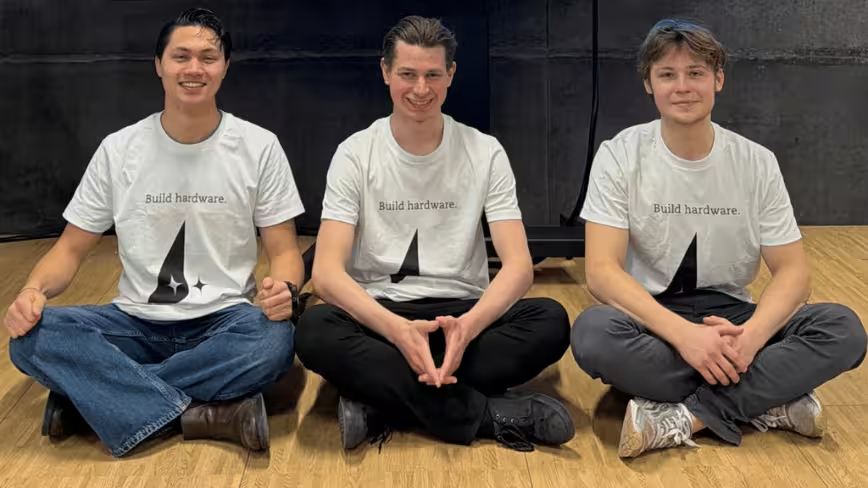
Atech: AI for Hardware Prototyping Secures Funding
Atech, an innovative startup based in Copenhagen, is making its mark in the field of artificial intelligence applied to hardware. The company recently announced the completion of a pre-seed funding round, attracting attention from international-caliber investors. Among its backers are well-known names in venture capital such as the Sequoia Scout Fund and the Andreessen Horowitz Scout Fund, joined by Nordic Makers, Emblem, and Lovable itself.
While the exact amount of funding was not disclosed, the participation of such prestigious funds underscores the potential recognized in Atech's business model. Anton Osika, CEO of Lovable, also expressed strong personal endorsement for the team, highlighting confidence in the Danish startup's vision and execution capabilities.
The Concept of "Vibe-Engineering" and Atech's Approach
At the core of Atech's offering is its ability to transform natural language descriptions into functional hardware prototypes. This approach, which the company terms "vibe-engineering," aims to drastically simplify and accelerate the development cycle, allowing designers and engineers to materialize complex ideas with greater fluidity.
Traditionally, hardware prototyping requires specialized skills in CAD, electronics, and mechanics, involving long and costly iterative cycles. The integration of artificial intelligence, as proposed by Atech, could democratize access to hardware creation, lowering technical barriers and enabling faster, more intuitive experimentation. This model aligns with the growing trend of leveraging Large Language Models (LLM) for more natural user interfaces and the automation of complex processes.
Implications for Hardware Development and the AI Context
The innovation proposed by Atech has significant implications for the entire hardware development sector. The ability to generate prototypes from simple text descriptions could drastically reduce the time-to-market for new products and solutions. For companies operating in technology-intensive sectors, such as robotics or IoT, this means greater agility in testing concepts and responding to market needs.
This approach fits into a broader context where AI is redefining design and production pipelines. For organizations evaluating the deployment of on-premise AI solutions, the ability to efficiently prototype hardware can be crucial for optimizing the local infrastructure required for inference or training. AI-RADAR, for example, offers analytical frameworks on /llm-onpremise to evaluate the trade-offs between self-hosted and cloud solutions, a fundamental aspect when considering the impact of new hardware development methodologies.
Future Prospects and the Role of Investors
The backing of high-profile investors like Sequoia and Andreessen Horowitz not only provides Atech with the necessary capital for growth but also confers significant strategic validation. These funds are known for their ability to identify and support companies with disruptive potential in the technology sector.
Atech's "vibe-engineering" could represent a step forward towards a future where hardware creation is more accessible and less constrained by current technical complexities. It remains to be seen how the startup will evolve its technology and what the first prototypes to emerge from this innovative AI-driven process will be, but the premises indicate an interesting path for the intersection of AI and physical design.







💬 Comments (0)
🔒 Log in or register to comment on articles.
No comments yet. Be the first to comment!