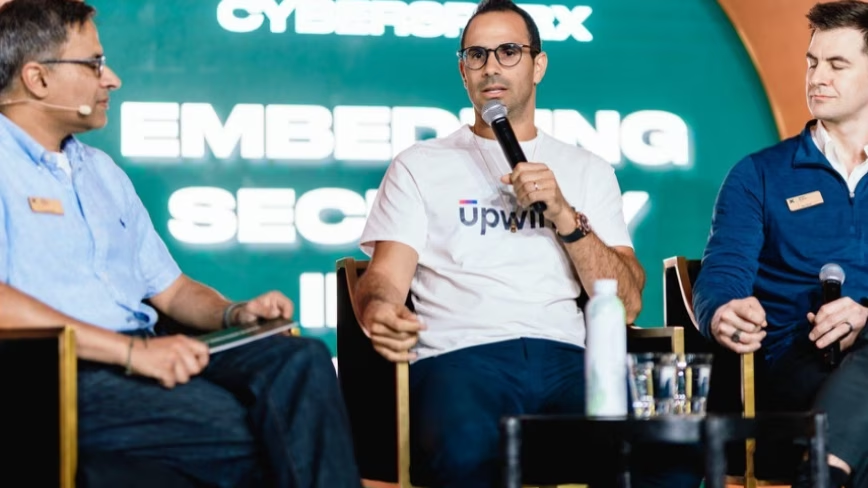
The news is a splinter that cracks the trust on which the entire modern development ecosystem rests. Security firm Upwind has linked the sabotage of multiple npm packages related to the AsyncAPI specification to a coordinated attack targeting the software release process. Not a vulnerability in the code, but an intrusion into the mechanisms that turn source into ready-to-use components — the very ones every developer installs without a second thought. It is a quiet paradigm shift, one that hits close to home for anyone who has chosen to bring Large Language Models behind their own firewalls.
For organizations running on-premises inference — with self-hosted stacks, dedicated servers, and full control over data — the meaning is immediate. The promise of digital sovereignty rests on the ability to certify every link in the chain. If a compromised npm package can slip into a monitoring dashboard or an orchestration tool that, in turn, talks to the model loaded in VRAM, physical separation from cloud infrastructure is no longer enough. The attack hit AsyncAPI, a specification adopted wherever event-driven architectures are built; its packages end up in the most disparate projects, including those surrounding LLM serving frameworks. The domino effect is concrete.
The point is not the single incident. It is what it reveals at a structural level. The open-source software supply chain has become a low-investment, high-yield attack vector, capable of bypassing classic perimeter defenses. Those managing on-premises deployments, perhaps in air-gapped configurations or with strict data residency policies, can no longer settle for static code analysis or maintainer reputation. They must shift verification upstream, onto the systems that produce the packages, and enforce deterministic build reproducibility within their pipeline. This means Software Bill of Materials (SBOM) tools, internal mirrors of public registries with cryptographic validation, and, ultimately, a heavier operational burden.
This is where the Total Cost of Ownership for on-premises gains an often-overlooked line item. It is no longer enough to buy GPUs, dimension VRAM for Llama or Mistral, and spin up an inference server like vLLM. One must budget for continuous dependency surveillance and the potential slowing of update cycles, because every new version must be inspected before entering the production environment. For some, this is an incentive to strike deals with vendors who distribute pre-verified binaries, but that clashes with the self-hosting philosophy, which thrives precisely on independence from the vendor. The tension is palpable.
The attack on AsyncAPI packages is not isolated; similar incidents have targeted PyPI, the registry crucial to the Python ecosystem on which nearly all machine learning frameworks rely. The lesson for those choosing local inference is stark: the attack surface is no longer just the model or the prompt, but also the connective tissue that transforms hardware into a working service. A compromise in that tissue can turn an on-premises server, designed to guard sensitive data, into an exfiltration vector. This is not science fiction: it is the predictable evolution of an ecosystem that made code distribution extraordinarily fluid but neglected the foundations of trust.
The path forward, for those unwilling to cede control, is forced: rebuild trust from the ground up, with reproducible builds, trusted signatures, and isolated staging environments. A cultural shift even before a technological one, but one that impacts timelines and budgets. And that, in the end, redefines the perimeter of data sovereignty: no longer just where the bits reside, but who guarantees the integrity of every line of code that processes them.








💬 Comments (0)
🔒 Log in or register to comment on articles.
No comments yet. Be the first to comment!