A Strategic Investment for the Future of Space
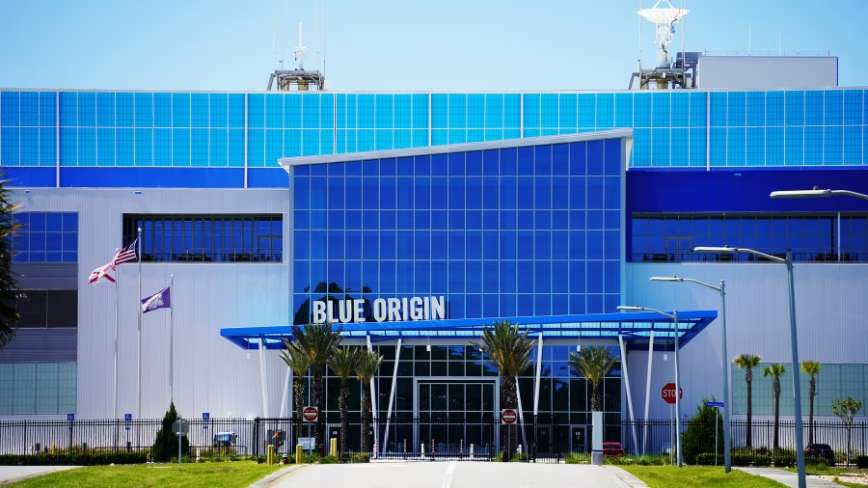
Blue Origin has announced a significant $600 million investment aimed at expanding its Florida campus. The initiative includes the construction of a new 830,000-square-foot factory in Cape Canaveral, within its Rocket Park complex. This project, named "Project Horizon," will be dedicated to the production of upper stages for rockets, a crucial component for the company's future space missions.
The announcement, made by Florida Governor Ron DeSantis, comes at a particularly dynamic time in the aerospace sector, just weeks before SpaceX's record IPO and approximately a month after a payload mishap involving the New Glenn rocket. This context highlights the highly competitive and high-stakes nature of the industry, where investments in proprietary infrastructure play a fundamental strategic role.
Investment Details and Infrastructure Implications
The scale of the investment and the size of the new facility, which will span over 77,000 square meters, underscore a clear strategy from Blue Origin: to consolidate control over its production pipeline. This decision to build and internally manage such a vast facility reflects an approach that prioritizes ownership and direct management of infrastructure, rather than relying on external providers or more flexible but less controllable solutions.
In the context of infrastructure decisions, this "on-premise" model presents significant analogies with the choices companies face in the deployment of Large Language Models (LLM) and other artificial intelligence applications. The initial investment (CapEx) is considerable, but it promises total operational control, the ability to customize the production environment, and, in the long term, a potential containment of the Total Cost of Ownership (TCO) compared to models based on external services with recurring operational costs. Sovereignty over production processes, in this case, is a key factor, just as data sovereignty is for companies managing sensitive LLMs.
Strategic Context and Parallels with AI
The choice of Cape Canaveral is not accidental. Florida is a strategic hub for the aerospace industry, offering a consolidated ecosystem and access to specialized resources. This strategic localization of physical infrastructure is also a crucial element in the world of AI, where proximity to data centers, power availability, and network connectivity can directly influence the performance and latency of inference and training systems.
Blue Origin's commitment to dedicated, owned physical infrastructure reflects a long-term vision that prioritizes resilience and internal innovation capabilities. For companies evaluating LLM deployment, similar decisions involve choosing between investing in bare metal hardware and local stacks, or adopting cloud services. While the cloud offers immediate scalability and flexibility, self-hosted solutions ensure greater control over security, compliance, and customization—fundamental aspects for sensitive workloads or those with specific performance and TCO requirements. AI-RADAR, for instance, offers analytical frameworks on /llm-onpremise to evaluate these trade-offs.
Future Outlook and Infrastructure Decisions
Blue Origin's investment represents a clear statement of intent: the company aims to strengthen its production autonomy and innovation capacity. This strategic move underscores how, in high-tech sectors, the ownership and control of physical infrastructure can be decisive for long-term success.
Similarly, in the artificial intelligence landscape, infrastructure decisions are not merely technical but strategic. Whether it's building a rocket factory or implementing an on-premise data center for LLMs, the choice between a self-hosted and a cloud-based approach involves a careful evaluation of costs, sovereignty, control, and adaptability to future needs. Blue Origin, with "Project Horizon," demonstrates a commitment to a model of total control that continues to be a benchmark for discussions on deployment strategies across all advanced technological domains.





💬 Comments (0)
🔒 Log in or register to comment on articles.
No comments yet. Be the first to comment!