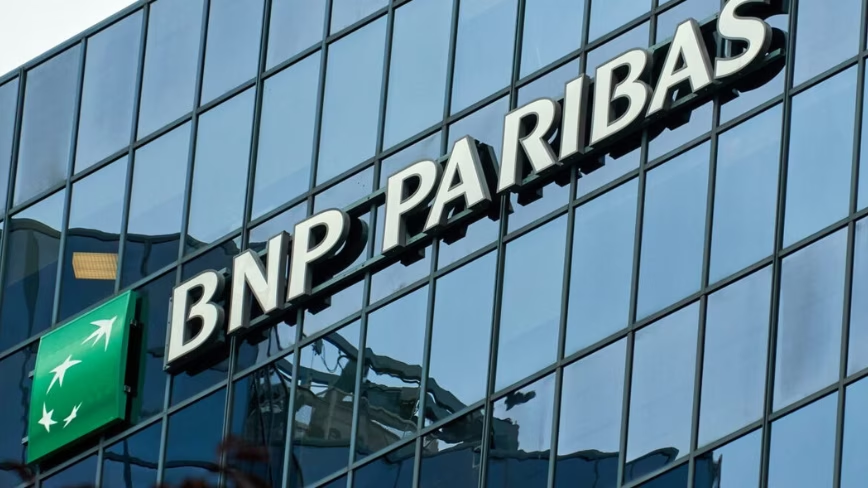
BNP Paribas and Mistral AI: An Alliance for European Cybersecurity
BNP Paribas, the Eurozone's largest bank by assets and headquartered in Paris, has initiated a strategic collaboration with Mistral AI. The objective of this partnership is the development of a new category of artificial intelligence-based cybersecurity tools. This initiative positions itself as a European answer to solutions already adopted by US counterparts, such as those offered by Anthropic with its Mythos model.
BNP Paribas' move, joining other European institutions in supporting Mistral AI, underscores a growing need for technological autonomy in the financial sector. The collaboration aims to bridge a perceived gap by providing tools that can be fully controlled and accessed by European supervisors, a crucial aspect for the continent's stability and regulatory compliance.
The Context of Data Sovereignty and Control
The primary motivation behind this collaboration lies in the difficulty, highlighted by a Bloomberg report, for European supervisors to reliably and fully access US-origin AI-based cybersecurity tools. This scenario raises fundamental questions regarding data sovereignty, compliance, and the ability of European institutions to maintain full control over their critical infrastructures.
For highly regulated sectors such as banking, ensuring that sensitive data remains within specific jurisdictions and that the tools used are transparent and auditable is of paramount importance. The choice to develop local or regional solutions, often with a self-hosted or on-premise approach, reflects the need to adhere to stringent regulations like GDPR and to mitigate risks associated with reliance on external providers not fully under European jurisdictional control. For those evaluating on-premise deployments, AI-RADAR offers analytical frameworks on /llm-onpremise to assess the trade-offs between control, costs, and performance.
Implications for the Financial Sector and Large Language Models
The application of Large Language Models (LLM) to cybersecurity in the financial sector is a rapidly evolving field. These models can potentially improve fraud detection, threat analysis, and security incident management by processing large volumes of unstructured data and identifying complex patterns. However, their deployment in a banking environment requires rigorous attention to security, privacy, and robustness.
Banks need AI systems that are not only effective but also explainable and unbiased, to avoid erroneous decisions that could have severe financial and reputational repercussions. The ability to fine-tune models on proprietary data, maintaining control over the entire model lifecycle, from training to inference, becomes a critical factor. This approach allows AI to be adapted to specific European needs and regulatory contexts, while ensuring maximum security and compliance.
Future Prospects and Strategic Trade-offs
The collaboration between BNP Paribas and Mistral AI represents a significant step towards building a more resilient and autonomous European AI ecosystem. This initiative highlights a broader trend in the industry, where large companies and institutions are carefully evaluating the trade-offs between adopting global cloud solutions and developing internal or regional AI capabilities.
The decision to invest in local solutions, although it may involve higher initial costs and longer development times, offers advantages in terms of control, data sovereignty, and customization. This is particularly true for sensitive AI workloads, where risk minimization and regulatory compliance are absolute priorities. AI-RADAR is committed to presenting these constraints and trade-offs, providing decision-makers with the necessary information to evaluate the best deployment strategies for their LLM workloads.






💬 Comments (0)
🔒 Log in or register to comment on articles.
No comments yet. Be the first to comment!