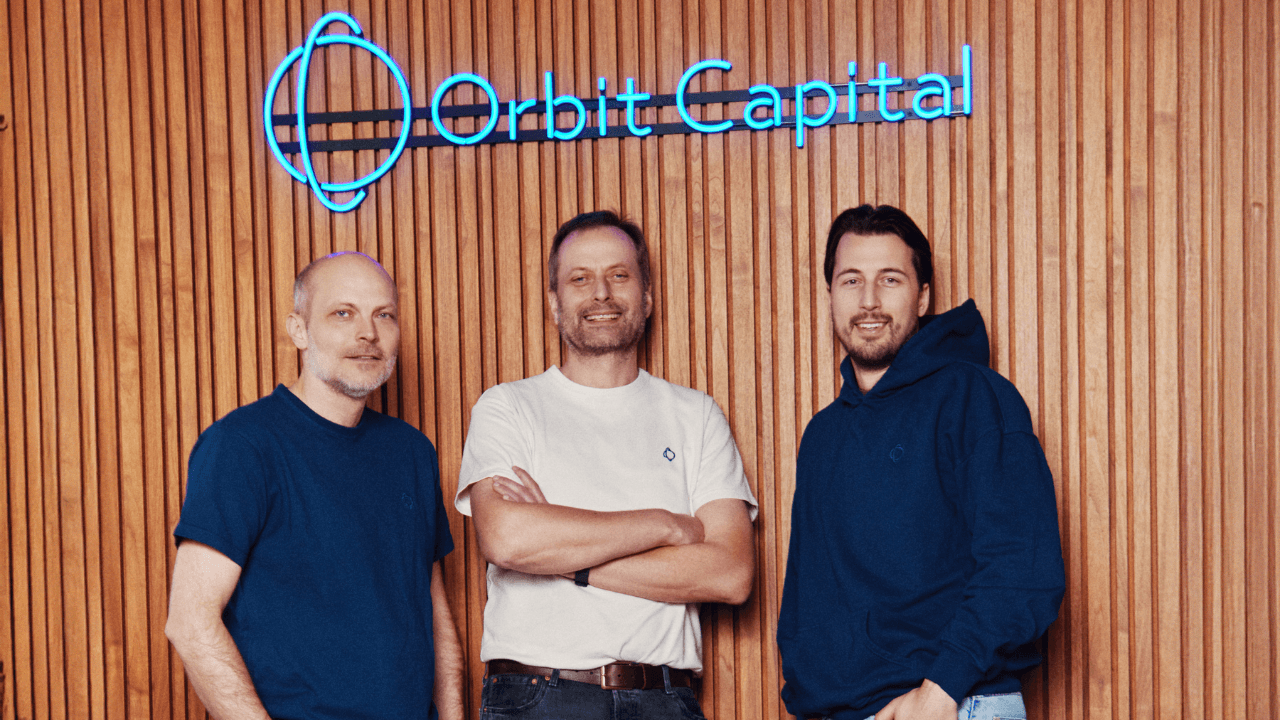
Orbit Capital announced the second closing of its Growth Debt Fund II at €107 million, a figure that surpassed the initial target and brought the vehicle well above market expectations for venture debt in Central and Eastern Europe. This is more than just a fundraising milestone: the fund’s anchor investors include the European Investment Fund (EIF), Česká spořitelna/Erste, Conseq and, for the first time in the region, a Czech private pension fund, Rentea. PFR Ventures, the largest institutional fund investor in CEE, is also making its debut in venture debt as an asset class, signaling that growth debt is gaining legitimacy even among pension schemes.
The mechanics are straightforward: Orbit provides non-dilutive debt capital to post-Series A technology companies with at least €3 million in revenue and minimum annual growth of 30%. Tickets range from €3 million to €15 million and may be used for international expansion, acquisitions, working capital and – importantly – capital expenditures. It is this last item that catches the eye of anyone currently evaluating on-premise deployment of large language models (LLMs). In Europe, companies that want to retain data control, reduce latency and keep total cost of ownership (TCO) under control over the medium term need to equip themselves with servers packing GPUs with high VRAM. Buying nodes with adequate compute capability – single units that can cost over a hundred thousand euros – requires upfront investment that traditional venture capital often does not cover without demanding additional equity.
Venture debt, on the other hand, provides liquidity without diluting ownership and can be layered on top of funds already raised. For a team that has built an LLM or a generative AI application and wants to run inference on its own hardware, Orbit’s financing offers strategic leverage: it can cover server purchases, networking infrastructure and the necessary storage, diluting founders far less than an equity round would. This structure is especially relevant in a CEE context where data sovereignty and GDPR compliance are pushing many enterprises to avoid the public cloud for sensitive workloads.
The deal signals a broader evolution. The allocation from pension funds and the EIF’s involvement show that venture debt is becoming a complementary channel to venture capital, precisely as demand for AI computing power explodes. For decision-makers in the AI-RADAR community, the shift from cloud rental to buying metal is not just a technology question: it is a financial choice that affects the balance sheet and the ownership structure. In an ecosystem where GPUs are scarce and lead times lengthen, having access to medium-term debt planned alongside one’s financial institution gives breathing room to companies that want to test and scale models without handing data to third parties.
Orbit has already begun deploying the fund’s capital: among the first five investments are the Czech startups Sloneek and IAG and the Polish startup Talkin’ Things. Although none of these companies explicitly operate in generative AI, the presence of flexible, non-dilutive capital in the CEE market raises the likelihood that the next scale-up deciding to handle inference on-premise will be able to do so with an experienced financial partner. It remains to be seen how many founders will seize the opportunity to move training and serving workloads onto dedicated hardware, but the financial instruments are now in place.








💬 Comments (0)
🔒 Log in or register to comment on articles.
No comments yet. Be the first to comment!