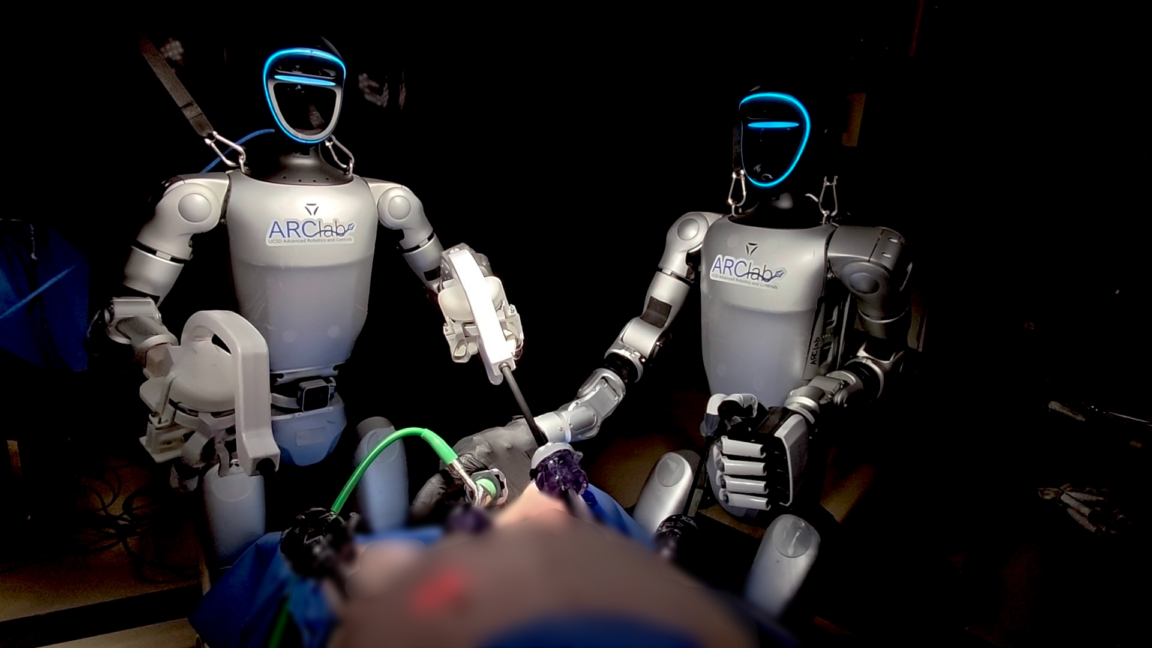
For the first time, humanoid robots removed gallbladders from live pigs under remote control by human surgeons. This is not another promise of medical automation; it’s a teleoperation experiment published in Nature that redraws the map of robotic surgery.
The goal is not to replace doctors with autonomous machines, but to decouple surgical skill from physical presence. Surgeons steered the robots from a distance, paving the way for procedures in small hospitals, war zones, or even space, where installing dedicated surgical robots like Da Vinci is logistically or financially impossible. Shanglei Liu, a professor at UC San Diego, summed up the advantage: the robots take up less room in the operating theatre and cost a fraction of traditional systems. The promise is deployment “from rural areas to the battlefield, and even to space.”
But the real bottleneck is not the robot; it’s the wire (or signal) connecting it to the surgeon. Telesurgery demands ultra-low latency, absolute reliability, and data security. This shifts the value chain: robotic hardware risks becoming a commodity – perhaps a standardized humanoid torso – while differentiation comes from network infrastructure (private 5G, dedicated fiber, future 6G links) and local compute power for real-time video processing, haptic feedback, and safety alarms. A distant cloud server is no longer enough; on-site edge computing is required, with guarantees of operational continuity and tamper-proofing.
This is where data sovereignty enters the picture. When a surgeon in Milan operates on a patient in Nairobi, clinical data crosses borders and jurisdictions. Where do pre-op scans, movement logs, and video recordings reside? Who is liable for a malfunction? Regulatory answers will inevitably push sensitive data processing on-premise, with an architecture that keeps health records at the point of care and transmits only compressed commands and feedback. Humanoid robots thus become terminals in a distributed system where sovereignty isn’t an option but a compliance requirement.
For those designing on-premise compute infrastructure, the lesson is clear: the next edge computing market won’t be limited to manufacturing or retail – it will include healthcare. Rural hospitals, mobile clinics, and military ships will need not just the robot, but certified local compute capacity, with hardware rugged against electromagnetic interference and instant disaster recovery. Companies that can deliver complete stacks – robot, network, compute, security – will gain ground in a sector long dominated by vertical integrators like Intuitive Surgical.
The pig experiment is a proof-of-concept that switches the conversation from robot autonomy to control-channel reliability. The next steps will be less spectacular and more structural: interoperability standards, low-latency network certification, and hybrid data architectures. Telesurgery is no longer science fiction; it’s a matter of investing in fiber, spectrum, and neighborhood servers.






💬 Comments (0)
🔒 Log in or register to comment on articles.
No comments yet. Be the first to comment!