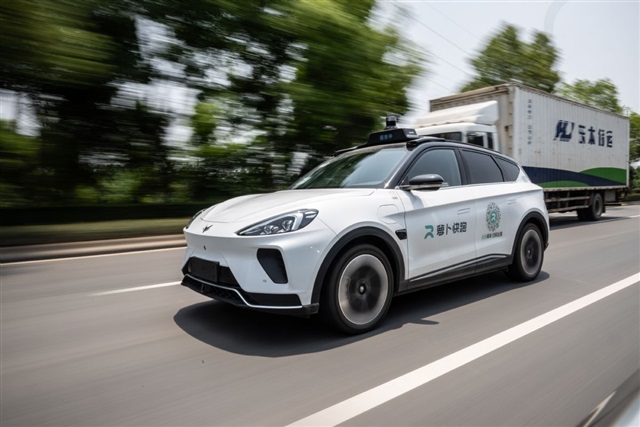
China Halts Autonomous Driving Permits After Baidu Incident
China has recently announced a moratorium on the issuance of new permits for autonomous vehicles. This decision, reported by Bloomberg, comes after an incident involving a robotaxi operated by Baidu, as part of its Apollo Go service. The episode highlights the increasing regulatory pressures and inherent challenges related to the safety and reliability of autonomous driving technologies.
The autonomous driving sector, while promising radical transformations in mobility, is constantly under scrutiny for its ability to operate in complex real-world scenarios. Any incident, even an isolated one, can have significant repercussions on development policies and deployment strategies at a national level, affecting not only the companies involved but the entire technological ecosystem.
Technological Context and Edge AI Challenges
Autonomous driving represents one of the most demanding applications for artificial intelligence, requiring real-time processing capabilities and unparalleled operational robustness. Autonomous vehicles must process enormous volumes of data from sensors (cameras, LiDAR, radar) and make critical decisions in milliseconds. This implies the need for extremely high-performance AI Inference systems, often based on Large Language Models (LLM) or complex neural networks, operating directly on board the vehicle, i.e., at the edge.
To ensure safety and responsiveness, these systems require dedicated hardware with high amounts of VRAM and Throughput, such as high-end GPUs, capable of handling intensive workloads with low latency. The choice of an edge or self-hosted deployment for critical data processing is not just a matter of performance, but also of data sovereignty and compliance. Sensitive information collected by vehicles must be managed securely and in accordance with local regulations, making public cloud solutions less suitable in many contexts.
Implications for Deployment and Regulation
The suspension of permits in China highlights how public trust and regulatory oversight are decisive factors for the large-scale adoption of autonomous driving. Incidents like the one involving Baidu Apollo Go can trigger thorough reviews of safety protocols and technological requirements, pushing companies to invest further in rigorous testing and more resilient infrastructures.
For organizations evaluating the deployment of critical AI systems, such as those for autonomous driving, a Total Cost of Ownership (TCO) analysis becomes fundamental. Self-hosted solutions, while requiring a higher initial investment (CapEx) for hardware like GPUs and servers, can offer long-term advantages in terms of control, data security, and operational costs compared to cloud-based models (OpEx). The ability to operate in air-gapped environments or with stringent compliance requirements often makes on-premise deployment the only viable option.
Future Prospects and the Role of Edge AI
Despite regulatory setbacks, the path towards full autonomous driving continues, albeit with greater caution. The focus is increasingly shifting towards the robustness of AI Frameworks, the quality of training data, and the ability to handle unforeseen scenarios. The role of Edge AI, with its promise of decentralized, low-latency processing, will be crucial in overcoming the remaining challenges.
For those evaluating on-premise deployment of LLMs and complex AI systems, AI-RADAR offers analytical frameworks on /llm-onpremise to assess the trade-offs between performance, cost, and control. The ability to manage model Inference and Fine-tuning in controlled and secure environments will be a distinguishing factor for the success of future generations of autonomous vehicles and other mission-critical AI applications.








💬 Comments (0)
🔒 Log in or register to comment on articles.
No comments yet. Be the first to comment!