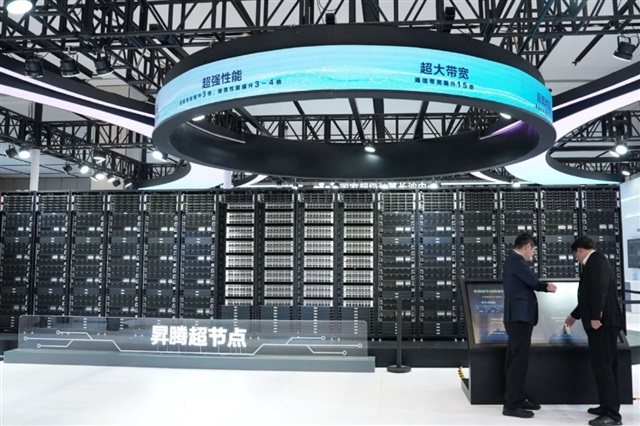
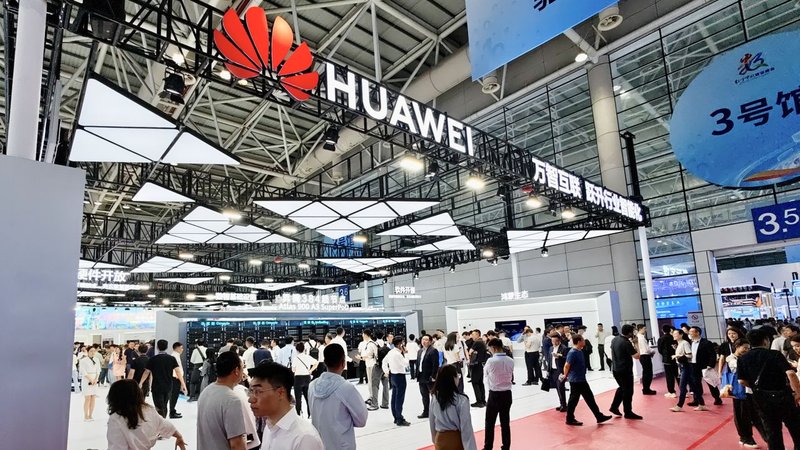
Shanghai served as the stage for an announcement that could reshape the global AI hardware landscape. At the World Artificial Intelligence Conference (WAIC), Huawei lifted the curtain on the Atlas 950, what the company calls a “supernode”—a dense concentration of compute power designed to train and serve Large Language Models in top-tier on-premise configurations.
The label is deliberate. Unlike a traditional server cluster, the supernode integrates dozens of Ascend accelerators (Huawei’s proprietary family) with high-bandwidth interconnects within a single chassis, slashing communication latency and simplifying thermal and power management. It’s an approach reminiscent of the modular architectures used by major cloud providers, but packaged for direct installation in enterprise or government data centers.
Here lies the turning point. While the Western world debates GPU availability and cloud access costs, China is pushing an alternative path: building monolithic systems optimized for specific workloads, sidestepping the constraints of U.S. export controls. The Atlas 950 competes not only on raw performance but on full infrastructure control. For organizations handling sensitive data—government, financial, healthcare—a self-hosted system of this scale reduces third-party exposure risks and eases compliance with local privacy regulations.
Winners and losers
The immediate effect is a strengthening of China’s domestic ecosystem. Local server manufacturers, system integrators, and managed service providers can build offerings around a compute node that is certified and directly supported by Huawei. On the flip side, NVIDIA sees the Chinese market slip further away—not just because of export bans, but because the availability of a vertically integrated alternative reduces the incentive to seek smuggling channels or hybrid architectures that circumvent sanctions.
Western cloud platform providers will also feel the move. The alliance between homegrown hardware and Chinese regional clouds (Alibaba, Tencent, Huawei Cloud) accelerates a regionalization of AI that fractures the global market into technological spheres of influence. This was already visible in software, but the advent of supernodes like the Atlas 950 makes it tangible at the silicon level.
Structural implications for on-premise deployment
For those evaluating on-premise LLM deployment, the supernode raises the bar of what can be done without scattering thousands of GPUs. Concentrating VRAM on a common backplane—without the need to manage inter-node network traffic—can reduce training times and simplify fine-tuning operations. Yet it introduces a different order of complexity: maintenance, energy consumption, and the upfront capital cost of a single system of this magnitude require dedicated expertise and financial planning distinct from more granular infrastructures.
It is no accident that Huawei is targeting a “rack-ready” form factor. The goal is to make high power accessible even to organizations that do not want to become cluster orchestration experts. The bet is that the Total Cost of Ownership, for iterative training and high-throughput inference workloads, can prove competitive even without the mature software ecosystem surrounding CUDA.
The real challenge now is software. The hardware can be impressive, but mass adoption will hinge on the maturity of development stacks and compatibility with major frameworks. On this front, China is investing heavily, yet the gap with the NVIDIA platform remains a factor to watch.






💬 Comments (0)
🔒 Log in or register to comment on articles.
No comments yet. Be the first to comment!