Two Competing Visions for Global AI Future
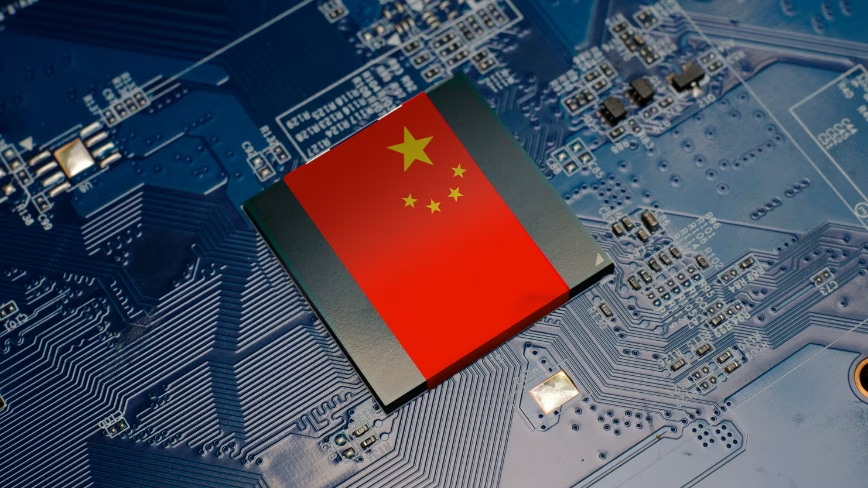
The geopolitical landscape of artificial intelligence is currently outlining two distinct approaches to its governance and distribution. On one hand, China, through its top diplomat Wang Yi, announced its intention to accelerate the establishment of a global AI cooperation organization, extending an invitation to all countries to join. This move suggests a vision of inclusivity and open collaboration in the field of artificial intelligence.
Concurrently, the recent G7 summit in France featured discussions centered on access to leading US Large Language Models (LLMs). According to Reuters, the focus was on how to grant such access exclusively to "trusted partners." This approach highlights a more selective strategy, potentially aimed at maintaining tighter control over advanced AI technologies, effectively creating two competing visions for the future of the global artificial intelligence ecosystem.
Implications for Data Sovereignty and Deployment
These strategic divergences have profound implications for organizations and nations evaluating the deployment of AI solutions. A restricted access model, such as that discussed by the G7, could push many entities to consider self-hosted alternatives or invest in developing local AI capabilities. Data sovereignty, regulatory compliance, and the need to operate in air-gapped environments become critical factors, making the adoption of external cloud-based LLMs less attractive or even impractical for some sectors.
The decision to rely on external models, potentially subject to geopolitical restrictions, introduces a level of risk and dependency that many companies and governments may wish to mitigate. This scenario strengthens the argument for direct control over AI infrastructure, from models to the underlying silicon. Evaluating the Total Cost of Ownership (TCO) for an on-premise deployment, which includes initial investments in hardware and expertise, becomes essential compared to the operational costs of cloud-based solutions, especially when data security and privacy are paramount.
The Role of Hardware and Local Stacks
To address the challenges posed by potentially limited access to leading AI models, investment in dedicated hardware and local software stacks is gaining increasing importance. The ability to perform LLM inference and fine-tuning on-premise requires significant computational resources, particularly GPUs with ample VRAM and robust compute capacity. The choice between different GPU architectures, such as NVIDIA A100 or H100 series, with their varying memory configurations and throughput, becomes a strategic decision for infrastructure teams.
In parallel, the development and adoption of open-source frameworks and pipelines for managing LLMs on bare metal or containerized infrastructures are crucial. These tools enable organizations to maintain full control over the model lifecycle, from optimization (e.g., through quantization) to deployment and monitoring. The ability to customize and adapt these local stacks ensures not only regulatory compliance but also the flexibility needed to respond quickly to business needs and technological evolutions, without relying on external providers.
Future Prospects for the AI Ecosystem
The coexistence of these two visions – one promoting open global cooperation and the other favoring controlled access – will profoundly shape the artificial intelligence ecosystem in the coming years. Political and diplomatic decisions will directly impact the technology adoption strategies of businesses and public institutions. For those operating in sensitive sectors or contexts with stringent data sovereignty requirements, the ability to autonomously develop and manage their AI capabilities will become a competitive and strategic factor.
In this context, the evaluation of on-premise and hybrid solutions for AI/LLM workloads is becoming increasingly relevant. AI-RADAR continues to provide analytical frameworks and technical insights on /llm-onpremise to help decision-makers navigate these complex trade-offs, offering concrete data on hardware, infrastructure, and TCO. The ability to maintain control over one's data and models, regardless of geopolitical dynamics, is emerging as a fundamental pillar for resilience and innovation.









💬 Comments (0)
🔒 Log in or register to comment on articles.
No comments yet. Be the first to comment!