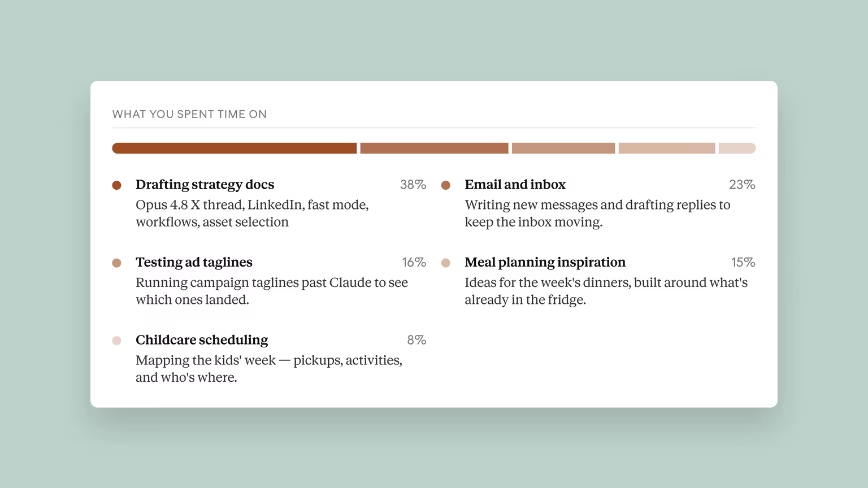
Anthropic released a beta feature on Thursday that goes against every instinctive business logic. It's called Reflect, a dashboard tucked into Claude's settings, and it tracks how much time and how many interactions you dedicate to the chatbot. Then, politely, it suggests you might want to use it a little less.
The irony is palpable: a company that monetizes access to its LLMs tells you to consume less of its product. But in the enterprise AI world, where every token has a cost and every API call impacts TCO, this gesture sounds more like a warning than a zen quirk.
Less consumption, more sustainability (or lower costs for someone)
The surface-level reading is about digital wellness: Anthropic aligns with trends around mental health and screen time, positioning itself as an ethical provider. But for those managing infrastructure or evaluating deployment strategies, the message is different: using Claude too much and too often might be economically unsustainable for both parties.
Companies that integrate cloud LLMs into their processes today are already grappling with unpredictable API bills and variable latency. If we add a provider that implicitly admits intensive use is undesirable, the scenario changes. It's no longer just a matter of cost optimization: it's a signal of a business model struggling to scale at the same voracity with which enterprises consume artificial intelligence.
The on-premise reflection
For those already evaluating or adopting a self-hosted approach with open-weight LLMs, the Reflect feature is almost a mirror. If the advice is "use the cloud less," the next question becomes: where do I run inference then? Sensitive data, repetitive queries, and low-latency tasks might find a home on in-house machines, perhaps with quantized models and targeted fine-tuning.
It's no coincidence that the debate around data sovereignty and TCO is increasingly central. A dashboard that counts interactions is an admission that every conversation has an operational weight for the provider and, by extension, for the end user. Shifting part of the workload to dedicated hardware (on-premise GPUs, optimized inference servers) becomes a strategic posture, not just a technical one.
More than a counter
Reflect might remain a curiosity, but it marks a rhetorical turning point. When an AI giant invites you to disconnect, it's also admitting that elastic cloud consumption has structural limits: energy costs, shared compute capacity, GPU saturation. The most attentive enterprises will read between the lines and start wondering if it's time to bring some intelligence home.
Those evaluating hybrid or on-premise deployments today know the trade-offs are complex. But tools like Reflect, however minimal, signal that the road to a cloud-only AI might be shorter than we like to think.








💬 Comments (0)
🔒 Log in or register to comment on articles.
No comments yet. Be the first to comment!