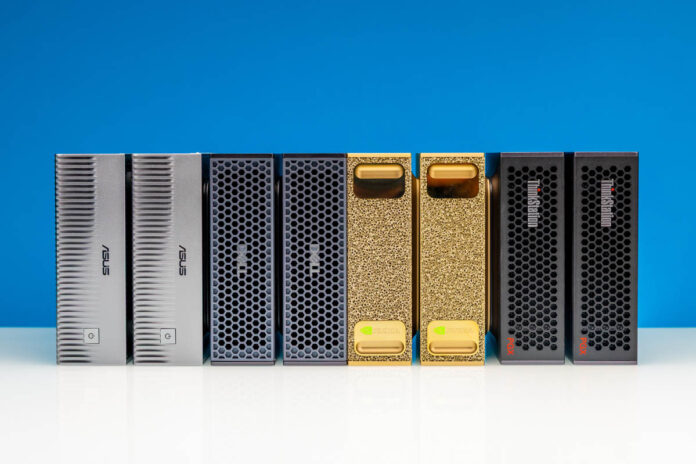
A New Approach to On-Premise AI Scaling
In the rapidly evolving landscape of artificial intelligence, the ability to scale infrastructure while keeping operational costs and energy consumption in check represents a critical challenge for enterprises. In this context, the construction of an AI cluster comprising eight NVIDIA GB10 units emerges as a significant example. The stated goal behind this realization was to demonstrate how it is possible to assemble a powerful system for AI workloads, characterized by relatively low power consumption.
This initiative underscores the importance of optimizing hardware and system architecture for the inference and training of Large Language Models (LLM) and other complex models. For organizations considering an on-premise deployment, energy efficiency directly translates into a more favorable TCO in the long term, reducing operational expenses related to power and cooling.
Architectural Details and Performance Implications
The core of this cluster is its eight NVIDIA GB10 unit configuration. While specific details of these units have not been disclosed, such a multi-GPU configuration is inherently designed to maximize computational parallelism. In LLM inference or training scenarios, a high number of GPUs allows for workload distribution, significantly accelerating throughput and reducing latency.
The scaling capability of a platform like this is fundamental for tackling increasingly larger models and complex datasets. The aggregation of VRAM and the bandwidth between GPUs, often ensured by high-speed interconnects, are key elements determining the overall performance of the cluster. The mention of "relatively little power" suggests careful design aimed at efficiency, an increasingly critical factor as AI computational requirements grow.
Advantages of On-Premise Deployment and Data Sovereignty
The choice to build a self-hosted AI cluster, such as the one based on NVIDIA GB10 units, reflects a growing trend among companies seeking greater control over their AI infrastructures. On-premise deployment offers distinct advantages in terms of data sovereignty, regulatory compliance, and security. Keeping data within the corporate perimeter is often an essential requirement for regulated industries or organizations with stringent privacy policies.
Furthermore, a self-hosted infrastructure allows for granular control over the hardware and software environment, enabling specific optimizations for enterprise workloads and the possibility of operating in air-gapped environments. For those evaluating on-premise deployments, AI-RADAR offers analytical frameworks on /llm-onpremise to assess the trade-offs between initial (CapEx) and operational (OpEx) costs, performance, and security requirements, providing a solid basis for informed decisions.
Future Prospects for Efficient AI Infrastructure
The realization of a cluster like the 8x NVIDIA GB10, which balances computing power and energy consumption, indicates the direction AI infrastructure development is taking. The industry is constantly seeking solutions that not only offer high performance but are also sustainable from an energy and economic perspective. Optimizing the performance-per-watt ratio has become a key metric for technical decision-makers.
This type of architecture demonstrates that AI scaling does not necessarily have to entail an exponential increase in costs or energy footprint. On the contrary, with targeted design and careful component selection, it is possible to build robust and performant systems that meet the control, security, and TCO requirements of modern artificial intelligence applications.










💬 Comments (0)
🔒 Log in or register to comment on articles.
No comments yet. Be the first to comment!