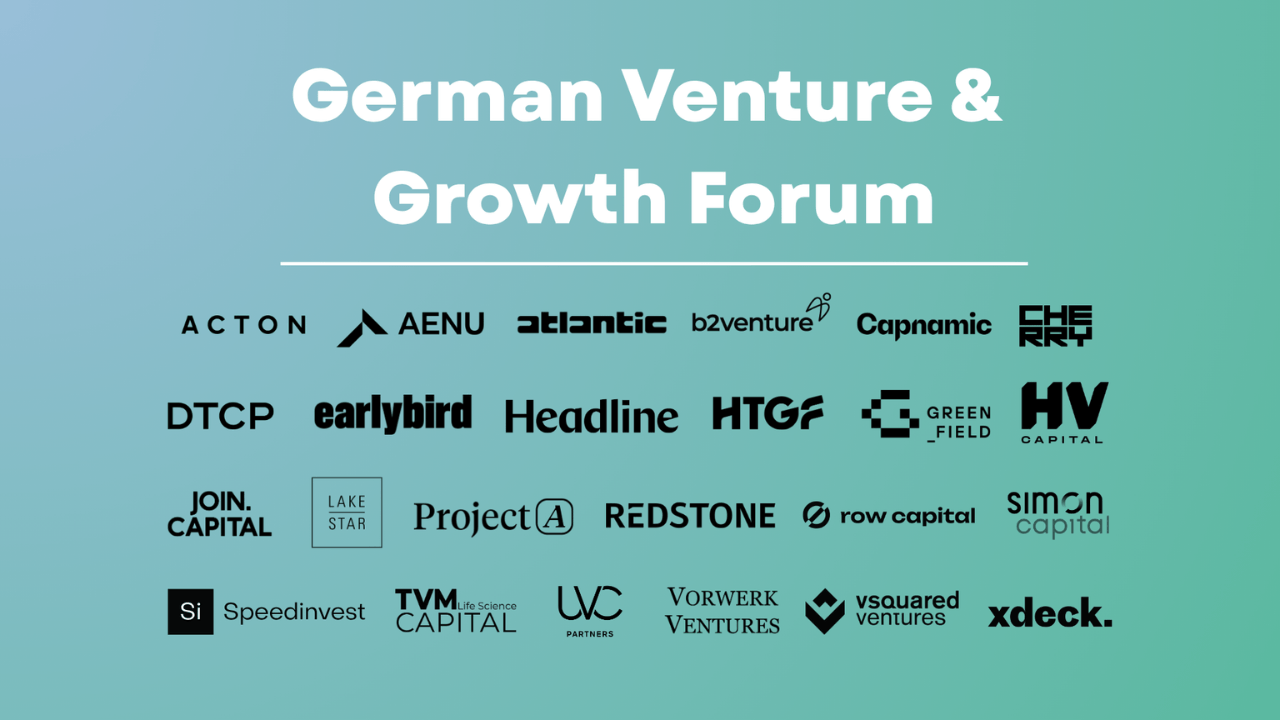
An Alliance for Growth Capital in Germany
Twenty-four of Germany's leading venture capital funds have joined forces to launch the German Venture and Growth Forum and publish the German Venture & Growth Playbook. This document, based on market data, analyzes the risk-return dynamics and investment potential of the venture capital asset class. The initiative was presented at the “Future at the table” event in Berlin, a side event to the SuperReturn conference, which saw the participation of prominent institutional figures such as Katherina Reiche, Federal Minister for Economic Affairs and Energy, Martin Blessing, Personal Representative of the Federal Chancellor for Investments, and Stefan Wintels, CEO of KfW Group.
The Playbook highlights how, with a targeted approach, €15 billion in existing private capital can be activated annually for German growth companies, while meeting market-aligned return expectations for investors. This increase in venture capital investments can generate stronger returns, help stabilize portfolios during turbulent markets, and accelerate the development of innovative businesses, ensuring the sustainability of employment in Germany. Such a strategy is fundamental for supporting the growth of high-tech sectors, which often require significant investments in research, development, and dedicated infrastructure, key elements for those evaluating on-premise deployment of advanced solutions.
Unlocking Potential: Investments and Impact on Innovation
VC-backed companies currently account for 40% of the market capitalization of the global top 100 and employ 2.3 million people worldwide. In Europe, analyses estimate that startups have the potential to create between 3.6 and 8.1 million additional jobs and generate up to $3.3 trillion in additional market capitalization, provided capital is available. Germany, with a strong industrial base and deep talent reserves, identifies access to capital as its main structural constraint.
German institutional investors manage approximately €2.8 trillion and, even with low-percentage allocations, could channel urgently needed additional capital into German and European growth companies. This model has long been established in markets such as the US, where it occurs without special funds or government guarantees, and with market-aligned return expectations. The availability of capital is an enabling factor for the development of frontier technologies, including Large Language Models (LLM) and other AI solutions, which require significant computing infrastructure and often lead to strategic decisions between on-premise and cloud deployment, influencing the overall TCO.
Investment Pathways for Institutional Investors
The Playbook serves as a guide for allocations by pension funds, insurance companies, professional pension schemes, and foundations. Recognizing that investors start from different positions, the German Venture & Growth Playbook presents a range of accessible approaches to investing in venture and growth capital, aligned with varying levels of expertise and organizational capacity. Single funds offer direct exposure to the performance of typically 20-30 portfolio companies with a clearly defined thematic or regional focus. The funds' general partners actively support their portfolio companies from the founding phase through to exit and invest in the funds themselves, creating a structural alignment of interests between fund management and investors.
Funds of funds further lower the barrier to entry by investing simultaneously in numerous individual funds and handling the entire fund selection and due diligence process, making them particularly suitable for investors without their own in-house VC team. The Wachstumsfonds Deutschland (Growth Fund Germany), launched at the end of 2023 with a volume of €1 billion, is a prominent example of this approach. Co-investments enable direct participation in individual transactions alongside established lead investors, offering higher return potential, a targeted risk profile, and typically lower fees. They are suitable as a complement to an existing fund allocation or for investors with a dedicated in-house investment team. For those evaluating on-premise deployment of AI solutions, the availability of capital for innovative startups can translate into a richer ecosystem of specialized hardware and software providers.
The Vision for a Technology-Driven Economy
According to investor Alexander Kudlich, the data is clear: the growing economic gap between the U.S. and Europe is largely based on a lack of growth capital. “Companies like the Magnificent Seven would never have emerged without VC investors. Startups don’t just develop disruptive technologies – they build the industries of the future. Germany has the resources to finance these industries precisely. With the German Venture and Growth Forum, we aim to address potential concerns and highlight concrete solutions for a reevaluation of VC.” Christian Nagel, Co-Founder and Partner at Earlybird, contends that the current generation of founders and young companies have the potential to kick-start Germany’s growth engine and build future industries in areas such as AI, fusion energy, robotics, quantum technology, and also in the defense and space sectors. “To achieve this, we need to scale these companies with the appropriate resources. Only in this way will we build the next generation of DAX 40 companies that keep the German business model of a technology-driven export economy alive.”
Dr. Tanja Emmerling, Partner at High-Tech Gründerfonds, concludes: “As a group of more than 24 German funds, our goal is to lower the barriers to entry for institutional investors and thereby lay the foundation for a high-performing capital structure – for innovation, startups, growth companies, and successful IPOs in Germany and Europe.” This drive to fund innovation is crucial for developing a robust technological infrastructure, which includes the capacity to support complex AI workloads, both through cloud solutions and, increasingly, via on-premise deployment, ensuring data sovereignty and control over operational costs.






💬 Comments (0)
🔒 Log in or register to comment on articles.
No comments yet. Be the first to comment!