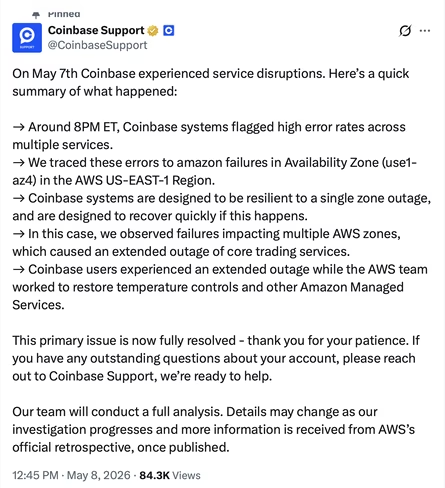
Coinbase: Layoffs, Losses, and a Seven-Hour Blackout Due to Overheated Data Center
Coinbase experienced one of the most challenging weeks in its recent history, marked by significant corporate decisions and an unexpected operational outage. The company announced 700 job cuts, a move reflecting current market dynamics and internal optimization strategies. This was compounded by the reporting of a $394 million quarterly loss, a figure that highlighted the financial challenges the exchange is facing.
The culmination of this series of events was a seven-hour blackout that affected the platform. This incident underscored the vulnerability of critical infrastructure, even for leading players in the cryptocurrency sector. The confluence of these factors created a picture of uncertainty, raising questions about the operational resilience and long-term strategy of the company in a volatile market context.
The Data Center Incident: A Warning on Reliability
The Coinbase service interruption was directly attributed to an overheated data center located in Virginia. This event caused a prolonged unavailability of the platform, preventing users from accessing their assets and conducting transactions for a significant period. Overheating in a data center can result from multiple factors, including cooling system malfunctions, power overloads, or hardware failures, all of which can severely compromise the stability of an infrastructure.
This episode emphasizes the crucial importance of robust physical infrastructure management. Regardless of whether a company opts for a self-hosted deployment or relies on cloud service providers, data center resilience remains a fundamental pillar. For organizations exploring the integration of Large Language Models (LLM) and other artificial intelligence solutions, the stability of the operating environment is an indispensable prerequisite to ensure the reliability and continuity of AI-driven services.
Implications for AI Deployment Strategies
The Coinbase incident offers a valuable lesson for CTOs, DevOps leads, and infrastructure architects evaluating their deployment strategies for AI/LLM workloads. Coinbase itself had previously communicated to its engineers the potential of artificial intelligence to accelerate processes that would typically take weeks, reducing them to just a few days. This statement stands in stark contrast to the reality of an outage caused by a fundamental infrastructure problem.
This scenario highlights that, however advanced the capabilities of LLMs and local stacks may be, their operation is intrinsically dependent on the solidity of the underlying infrastructure. Deployment decisions, whether for on-premise, hybrid, or cloud-based solutions, must always consider physical resilience, redundancy, and disaster recovery plans. The Total Cost of Ownership (TCO) of an AI solution is not limited to hardware and software costs but also includes potential costs arising from outages, reputational damage, and lost opportunities. For those evaluating on-premise deployments, AI-RADAR offers analytical frameworks on /llm-onpremise to assess complex trade-offs between control, data sovereignty, and operational costs.
Lessons for Operational Resilience in the AI Era
Coinbase's turbulent week serves as a reminder that, even in the era of artificial intelligence and advanced automation, the physical foundations of technological infrastructure remain irreplaceable. A company's ability to fully leverage the potential of LLMs and other AI technologies is directly proportional to the robustness and reliability of its operational environment.
For technical decision-makers, it is crucial to adopt a holistic approach to infrastructure planning. This includes not only the selection of GPUs and the configuration of clusters for inference and training but also ensuring that data centers are equipped with adequate cooling systems, redundant power supplies, and rigorous security protocols. Only then can the promises of efficiency and innovation offered by AI translate into concrete and sustainable benefits, without being undermined by foreseeable infrastructure failures.









💬 Comments (0)
🔒 Log in or register to comment on articles.
No comments yet. Be the first to comment!