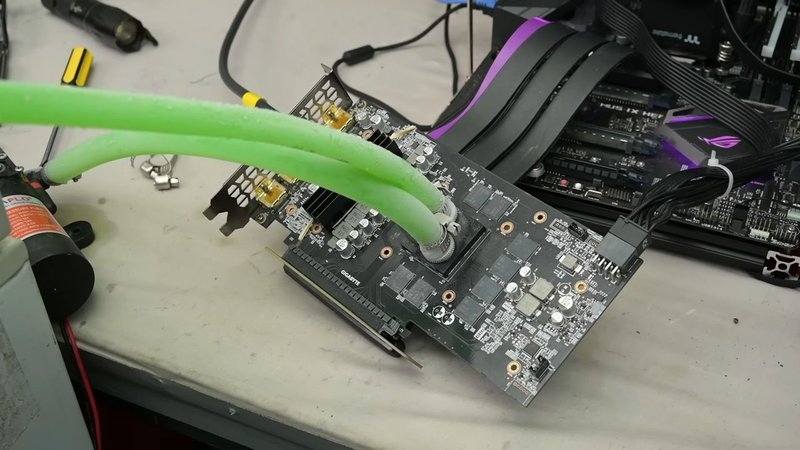
George Hotz has never hidden his distrust of components that cannot be inspected. With Comma.ai and Tinygrad he announced two docks that turn a USB4 port into a connection for PCIe Gen4 x4 accelerators: the Tiny Chestnut, designed as an eGPU dock, and the Chestnut, which ships with an AMD Radeon RX 9060 with 8GB of VRAM. The detail that separates this from an ordinary hardware announcement is the open-source firmware.
Why open firmware changes the calculation
In a traditional eGPU dock, the controller managing power, enumeration, and PCIe transfers is a black box. Users cannot verify how the device negotiates the connection with the operating system, nor whether there are hidden behaviors. The choice by Comma.ai and Tinygrad moves the openness boundary: no longer just drivers or frameworks, but the firmware beneath the accelerator. For a team evaluating self-hosted deployment, this is not an ideological quirk. Inspectable firmware means being able to document the hardware chain in audit processes and reduce dependence on a vendor for updates and fixes.
There are no benchmarks in the announcement, and the bandwidth of a PCIe Gen4 x4 link carried over USB4 should not be compared to an internal x16 slot. But for inference workloads on compact models, a local node with 8GB of VRAM can serve as a low-cost testbed, especially when paired with quantization techniques that reduce the memory footprint of models.
Who gains and who loses
Developers and system administrators who build local workstations or labs where controllability matters more than peak performance stand to gain first. The combination of a framework like Tinygrad and a dock with open firmware creates a more transparent path from software to hardware. Potential losers are makers of proprietary enclosures and controllers, who must now explain why their firmware cannot be opened.
The move has a second-order effect: it normalizes the idea that openness in AI does not have to stop at model weights or inference libraries but can extend to the physical components that run them. One obvious limit remains: open firmware does not automatically make the GPU driver open, and consumer GPU drivers remain proprietary. That tension, more than the dock's specifications, is what makes the announcement interesting for anyone watching the evolution of local AI hardware.





💬 Comments (0)
🔒 Log in or register to comment on articles.
No comments yet. Be the first to comment!