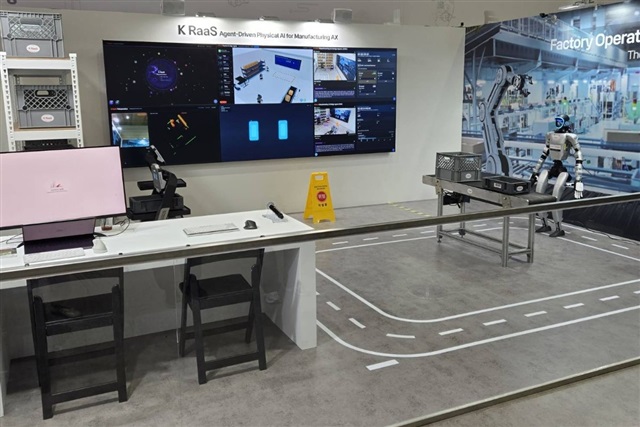
South Korean Telcos Unveil "Full-Stack" AI Strategies at WIS 2026
At the World IT Show (WIS) 2026, leading South Korean telecommunications operators presented their ambitious artificial intelligence strategies, adopting a "full-stack" approach. The announcement highlighted a significant commitment to developing AI agents, enhancing underlying infrastructure, and integrating AI into the roadmap for 6G. This holistic vision reflects the growing awareness within the industry of the need to control every layer of AI technology, from user applications to the hardware and software systems that support them.
The move by the Korean giants is not merely a statement of intent but a clear signal of the direction the telecommunications sector is taking. Deep integration of AI is seen as fundamental not only for optimizing existing operations but also for unlocking new service opportunities and improving user experience in an increasingly connected and data-driven era.
The "Full-Stack" Approach: Agents, Infrastructure, and Control
The concept of a "full-stack" AI strategy implies control and development extending from the user interface, represented by intelligent "agents," to the core of the technological infrastructure. For telecommunications companies, this means not only creating innovative AI services but also building and managing the computational environment necessary for training and Inference of Large Language Models (LLM) and other artificial intelligence models. Such an approach requires significant investment in specialized hardware, such as high-performance GPUs, and in software solutions for orchestration and Deployment.
Managing such complex AI infrastructure raises crucial questions regarding Total Cost of Ownership (TCO), data sovereignty, and regulatory compliance. Many organizations, especially in regulated sectors like telecommunications, are carefully evaluating the trade-offs between adopting external cloud services and building self-hosted or hybrid AI capabilities. On-premise solutions offer greater control over data and security, which are fundamental aspects for customer trust and compliance with privacy regulations.
The Crucial Role of AI Infrastructure for 6G
The announcement by the Korean giants also highlights the intrinsic link between the evolution of AI and the development of future 6G networks. 6G is, in fact, destined to be an inherently intelligent network, which will leverage AI to optimize performance, dynamically manage resources, and enable ultra-reliable, low-latency services. This will require a distributed AI infrastructure, capable of processing enormous volumes of data in real-time, often at the network edge (edge computing).
The design of this infrastructure must consider not only computing power but also high-speed connectivity and storage capacity. For those evaluating on-premise Deployment of LLMs and other AI solutions, it is essential to carefully analyze VRAM, throughput, and latency requirements, as well as consider integration with existing and future networks. The ability to manage complex AI workloads in controlled and secure environments will be a distinguishing factor for success in the 6G landscape.
Strategic Implications and Future Prospects
The "full-stack" AI strategies presented by the South Korean telcos represent a model for the global sector. The emphasis on building internal AI capabilities, from application to infrastructure, reflects a broader trend towards greater technological autonomy and tighter control over data and operations. This approach is particularly relevant for companies operating in contexts where data sovereignty and security are absolute priorities.
For enterprises exploring the implementation of LLMs and other AI solutions, the lesson is clear: the choice of deployment architecture – whether on-premise, cloud, or hybrid – must be guided by a thorough analysis of TCO, compliance requirements, and specific performance needs. AI-RADAR offers analytical frameworks on /llm-onpremise to help evaluate these trade-offs, providing neutral guidance for complex strategic decisions. The ability to integrate AI cohesively and securely will be crucial for future competitiveness.








💬 Comments (0)
🔒 Log in or register to comment on articles.
No comments yet. Be the first to comment!