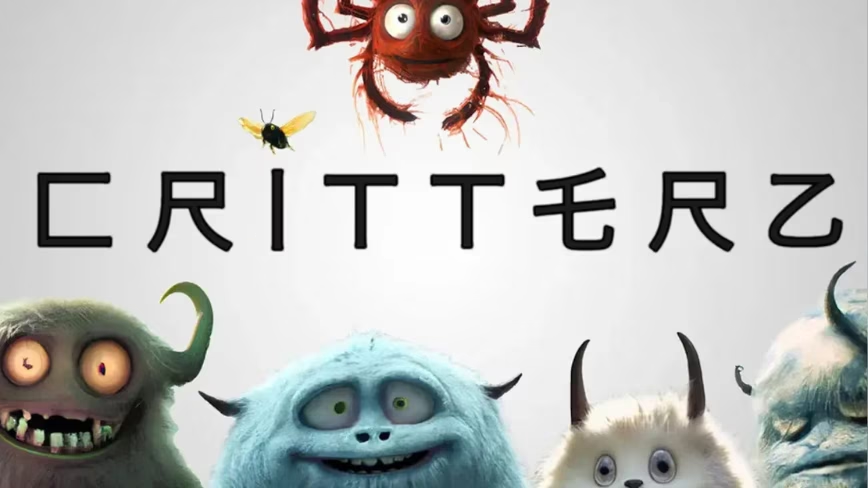
The Critterz Precedent: When Generative AI Meets Market Reality
The film production world has closely watched the "Critterz" project, an animated feature backed by OpenAI and ambitiously presented as the first major commercial work created entirely through a generative artificial intelligence pipeline. The goal was to demonstrate the maturity of these technologies in a mainstream production context, opening new frontiers for the creative industry. However, "Critterz" encountered an unexpected setback, preventing it from reaching its presentation window at the prestigious Cannes festival.
The reason for this hurdle is as simple as it is significant: the generative AI video model upon which the entire project was built is no longer available. This event raises crucial questions about the sustainability and reliability of production pipelines that heavily depend on third-party models, especially when these are subject to sudden changes or complete deprecation.
Technical Implications of External Model Dependency
The "Critterz" incident highlights a fundamental problem for companies integrating Large Language Models (LLM) or other generative AI models into their operational processes: dependency on the lifecycle and release policies of external providers. When a critical project, such as film production, relies on a specific model, its sudden disappearance can have devastating consequences, nullifying months or even years of work and investment.
For CTOs, DevOps leads, and infrastructure architects, this scenario underscores the need to carefully assess the risks associated with adopting AI services and models not directly controlled. Model volatility, API changes, alterations in terms of service, or the cessation of support are factors that can compromise the stability and operational continuity of a pipeline. The choice of a model is not just a matter of performance or functionality, but also of governance and longevity.
Data Sovereignty and Control: The On-Premise Perspective
The "Critterz" experience strengthens the argument for deployment strategies that prioritize control and data sovereignty. For organizations managing critical AI/LLM workloads, adopting self-hosted or on-premise solutions offers a level of autonomy and stability that third-party cloud services cannot always guarantee. Having direct control over the infrastructure, models, and development pipeline means being able to mitigate risks related to sudden model deprecation or unannounced changes.
An on-premise deployment, while requiring an initial investment in hardware (such as GPUs with adequate VRAM for inference and fine-tuning) and internal expertise, can lead to a more predictable TCO and greater long-term resilience. This approach allows companies to maintain full intellectual property and sovereignty over their data, a crucial aspect in regulated sectors or for projects with high security requirements, such as air-gapped environments. AI-RADAR offers analytical frameworks on /llm-onpremise to evaluate these trade-offs, helping decision-makers compare the costs and benefits of different deployment architectures.
Mitigation Strategies and Future Outlook
The "Critterz" incident serves as a warning to the industry, emphasizing the importance of risk mitigation strategies in designing AI-based pipelines. This includes model diversification, creating fallback or contingency plans, and thoroughly evaluating the roadmap and stability of model providers. For future productions intending to leverage generative AI, balancing innovation with operational robustness will be essential.
The choice between a cloud, hybrid, or fully on-premise deployment is never trivial and depends on a careful analysis of specific project requirements, budget constraints, and risk tolerance. The "Critterz" episode highlights that while generative AI opens unprecedented creative opportunities, its real-world implementation demands infrastructural and strategic planning that extends beyond mere model functionality, embracing aspects of control, sovereignty, and operational continuity.







💬 Comments (0)
🔒 Log in or register to comment on articles.
No comments yet. Be the first to comment!