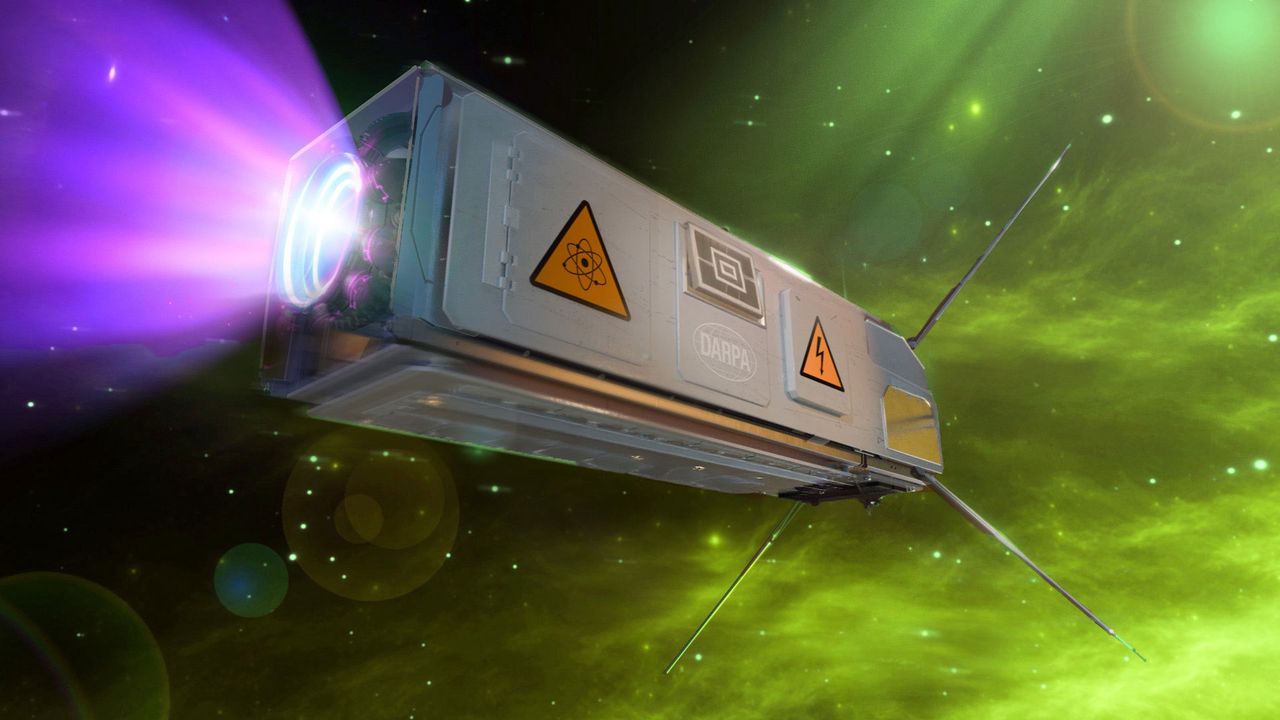
DARPA has turned the spotlight on an old engineering dream: turning nuclear waste into batteries capable of delivering power for 30 years without recharging. The project, named SYMPHONEE, aims to harness Strontium-90, a radioactive isotope produced in fission reactors, to power next-generation military drones.
This isn’t a standard chemical battery. Betavoltaic cells – already used in pacemakers and space probes – convert beta particle energy directly into electricity through semiconductors. Strontium-90 has a half-life of roughly 29 years and a theoretical energy density thousands of times higher than lithium, providing a stable power flow for the vehicle’s entire operational life.
Why it matters for on-field AI computing
A drone that can stay airborne or on alert for months without relying on charging infrastructure becomes a fully autonomous edge computing node. Optical sensors, radar, and encrypted data streams require immediate local inference: a small, quantized LLM optimized for on-board execution could analyze the operational context and make decisions without ever pinging a remote server. A nuclear battery removes the recharging bottleneck and dramatically lowers the TCO of a distributed fleet, shifting the comparison from cost per watt-hour to cost per watt-hour-per-decade.
For those evaluating on-premise deployments in extreme scenarios – border surveillance, environmental monitoring in disconnected areas, disaster recovery – the combination of long energy autonomy and local AI touches two pillars of the AI-RADAR perspective: data sovereignty and full hardware control. Models run locally, data never leaves the device, and latency is never an issue. The absence of mandatory cloud connectivity makes the system immune to interception or network outages, a non-negotiable advantage in military contexts.
The trade-offs of an unconventional energy source
The use of radioactive material, even in ceramic and poorly soluble form, raises safety and proliferation concerns that remain confined to the military domain for now. The minimum size of a betavoltaic generator is still limited by semiconductor surface area; conversion efficiency rarely exceeds 10%. Instantaneous power cannot match chemical batteries for peak loads, pushing designers toward hybrid architectures with supercapacitors to handle computational spikes.
Horizontal scalability of this technology is yet to be demonstrated: a swarm of nuclear drones would require maintenance and disposal procedures that have no civilian counterpart today. Yet, from a pure endurance standpoint, the leap is so large that it deserves attention. If SYMPHONEE produces working prototypes, the line between an infinite-energy vehicle and a stable edge computing platform could blur, opening new scenarios for those designing AI infrastructure away from power outlets.






💬 Comments (0)
🔒 Log in or register to comment on articles.
No comments yet. Be the first to comment!