
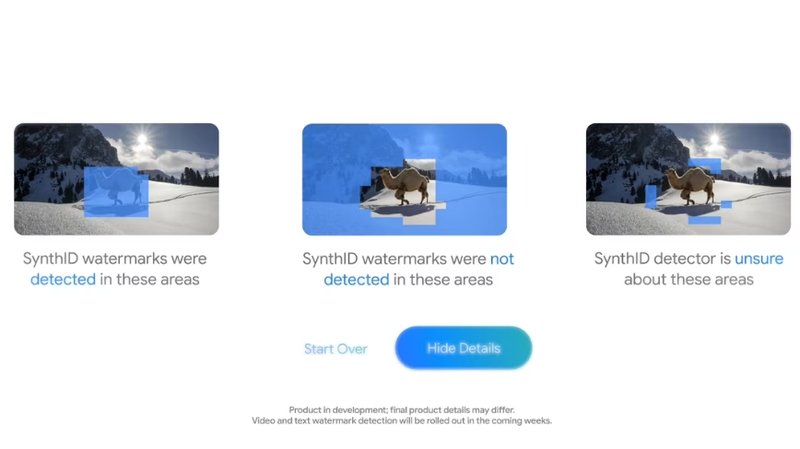
The picture looked real: Senator Mitch McConnell slumped on a hospital bed, tubes and monitors everywhere, his face contorted in a kind of suffering that screamed truth. Within hours the image bounced across social networks and chats, primed to become yet another disinformation weapon of the election cycle. Then it stopped. Google's deepfake detection system—likely SynthID for images or a similar tool—certified the synthetic nature of the shot, bringing the debate back to the ground of reality.
Yet the speed and effectiveness of that debunking raise a question that goes well beyond a single incident: where exactly did the check run? We don't know for sure, but the overwhelming majority of deepfake detection services from major vendors—Google, Microsoft, startups—operate as cloud APIs: you upload a piece of content to a remote server, you get a verdict. For an independent fact-checker or a newsroom under deadline, that's a handy workflow. For a government office, an intelligence agency, or a company handling sensitive material, it's a crack in data sovereignty.
Sending suspect content to an external service means sharing metadata, investigation patterns, and, in some cases, confidential information with a third party. This isn't paranoia: in information warfare scenarios, the detection provider can itself become an actor or a target. The fix for those who can afford it is to bring the model home. Running inference on one's own hardware, in an air-gapped environment or on a private cloud, returns full control over the decision chain.
It's not a path without obstacles. The most advanced detection models, often based on convolutional networks or transformers trained to spot generation artifacts, have non-trivial compute needs. A high-resolution image can take several seconds on a GPU with 8–12 GB of VRAM, while sustained loads—like real-time screening of video feeds—require multi-GPU setups or dedicated accelerators. Quantization helps reduce the footprint, but it can hurt model sensitivity, opening the door to false negatives.
Those who choose self-hosted don't do it for better performance; they do it to eliminate a risk of lock-in and exposure. The McConnell case illustrates this in negative space: Google did its job, but it did so with its own stack, its own policies, its own legal jurisdiction. If tomorrow the same detection had to operate on images of abuse, sealed court proceedings, or classified communications, the calculus shifts. It becomes part of a broad TCO strategy where hardware costs are amortized against the certainty that nothing leaves the corporate perimeter.
On the regulatory side, the European Union with the AI Act and GDPR already push toward a principle of processing proximity. Running detection on-premise isn't yet mandatory, but for high-risk contexts the direction is clear. Organizations that begin building local verification pipelines today—integrating an open-source detector, provisioning a Kubernetes node with an open-weight model, managing the versioning of training datasets—are preparing for a scenario where compliance won't just be preferable but binding.
In the end, the McConnell deepfake is more than an anecdote from the information wars. It's a signal: detection is becoming professionalized, and with it the need to decide where it runs. For organizations that really want to own the verification process, the game is no longer only about model accuracy, but about deployment architecture.







💬 Comments (0)
🔒 Log in or register to comment on articles.
No comments yet. Be the first to comment!